2026-09-04 カロリンスカ研究所(KI)
<関連情報>
- https://news.ki.se/autoimmune-diseases-share-genetic-patterns
- https://www.jci.org/articles/view/205952
全国規模の兄弟姉妹研究における自己免疫疾患間の遺伝的相関の組織特異的クラスター化 Tissue-specific clustering of genetic correlations across autoimmune diseases in a nationwide sibling study
Daniel Eriksson, Ralf Kuja-Halkola, Marie E. Holmqvist, Henrik Larsson, Agnieszka Butwicka, Soffia Gudbjörnsdottir, Olle Kämpe, Sophie Bensing, and Jakob Skov
Journal of Clinical Investigation Published: August 3, 2026
Abstract
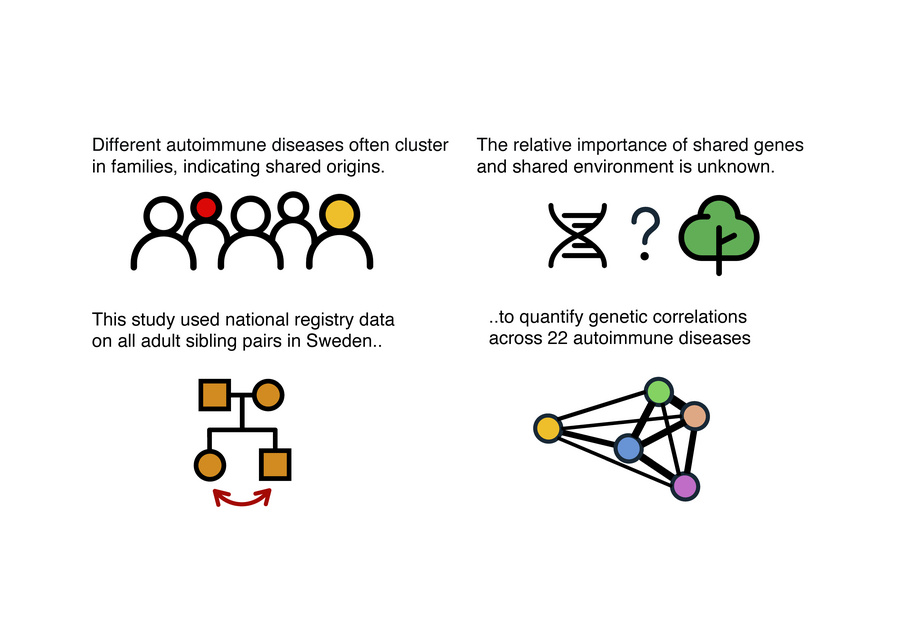
Background Autoimmune diseases (ADs) often co-occur within individuals and families, indicating shared genetic risk factors. However, the composition of genetic overlap across autoimmunity is largely unknown. Methods This nationwide study included 6,336,615 individuals born in Sweden between 1932 and 1983, comprising 3,839,400 full-sibling pairs. Based on national heath-registers, 22 ADs were identified from 1969-2013. Aggregation and co-aggregation of ADs among siblings was used to estimate pairwise genetic correlations of ADs under a liability-threshold model. Network analysis and principal component analysis was used to characterize the structure of shared genetic risk across ADs. Results A total of 707,995 individuals (11.2%) were diagnosed with at least one AD. The studied ADs formed a network of significant genetic correlations (mean rg = 0.24, range 0.08-0.84) with clusters of more closely related ADs (rg ≥ 0.3). We found no evidence of a significant universal factor predisposing to autoimmunity. Conclusions This study demonstrates that ADs share substantial cluster-specific genetic overlap that largely aligns with affected tissue types, leading to distinct groupings of connective tissue diseases, gastrointestinal disorders, and endocrinopathies, whereas diseases of the nervous system show limited genetic cohesion. This suggests that shared biological mechanisms may drive coaggregation within disease groups. Clinically, these insights highlight the importance of monitoring patients and their relatives for related autoimmune disorders. Funding The Swedish Society of Medicine, Region Värmland’s County Research Council, The Swedish Research Council, the Knut and Alice Wallenberg Foundation, The Regional Agreement on medical training and Clinical research (ALF) between Stockholm County Council and Karolinska Institutet