2026-09-08 合肥物質科学研究院(HFIPS)
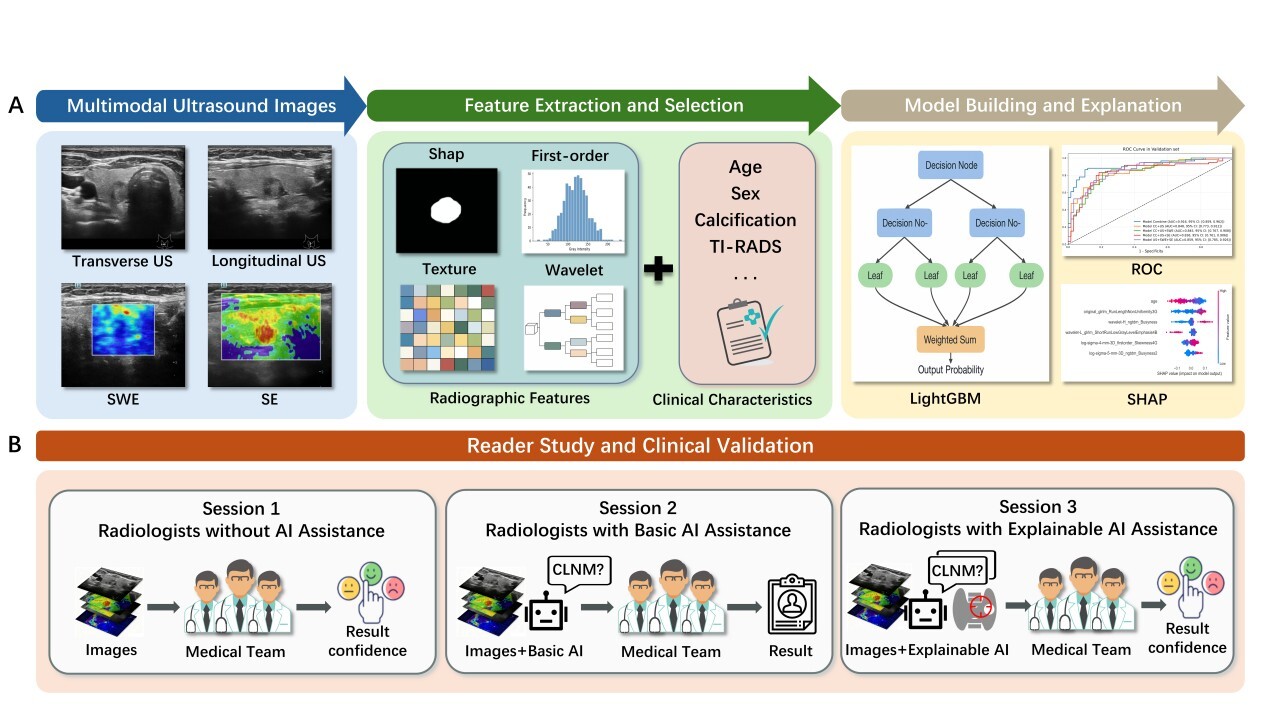
Clinical validation workflow for the explainable AI system combining multimodal ultrasound to predict central lymph node metastasis in papillary thyroid carcinoma (Image by WANG Tengfei)
<関連情報>
- https://english.hf.cas.cn/nr/rn/202609/t20260908_1192743.html
- https://link.springer.com/article/10.1007/s10278-026-02141-5
乳頭状甲状腺癌における中心リンパ節転移の術前リスク層別化のための、説明可能なAI支援型マルチモーダル超音波ラジオミクス Explainable AI–Assisted Multimodal Ultrasound Radiomics for Preoperative Risk Stratification of Central Lymph Node Metastasis in Papillary Thyroid Carcinoma
Zhengqin Huang,Junjie Wang,Meiwen Chen,Xuan Chu,Jingyu Li,Xiyan Sun,Lizhuang Yang,Stephen TC Wong,Yongchao Chen,Tengfei Wang & Hai Li
Journal of imaging Informatics in Medicine Published:29 July 2026
DOI:https://doi.org/10.1007/s10278-026-02141-5
Abstract
The objective was to develop and validate an explainable artificial intelligence (AI)–based multimodal approach for preoperative risk stratification of central lymph node metastasis (CLNM) in papillary thyroid carcinoma (PTC) and to evaluate its role in supporting radiologist decision-making. This multicenter retrospective study enrolled patients with pathologically confirmed PTC from four hospitals. Preoperative two-dimensional ultrasound, strain elastography, shear-wave elastography, and clinical variables were integrated to develop a multimodal predictive model. Model interpretability was achieved using SHapley Additive exPlanations (SHAP) to provide feature-level explanations supporting clinical interpretation. To assess clinical usability, a controlled reader study was conducted in which six radiologists with varying experience independently evaluated cases under three conditions: without AI assistance, with basic AI assistance (probability output only), and with explainable AI assistance (visualized feature-level contributions). Model performance was evaluated using the area under the receiver operating characteristic curve (AUC), and reader performance was assessed using paired statistical comparisons and interreader agreement analysis. A total of 428 patients (mean age, 44 years ± 12; 369 women) with 508 PTC nodules were included, of whom 225 (44.3%) had CLNM. The multimodal model achieved AUCs of 0.975, 0.917, and 0.844 in the training, validation, and external test cohorts, respectively, outperforming single-modality and simplified fusion approaches (p < 0.05). SHAP identified age, texture-derived radiomic features, and elastography-derived stiffness-related features as key contributors. In the reader study, explainable AI assistance significantly improved diagnostic accuracy across all experience levels, increased diagnostic confidence, and raised human–AI agreement to substantial or almost-perfect levels. An explainable AI–based multimodal approach enables accurate preoperative risk stratification of CLNM in PTC and improves radiologist diagnostic performance, with potential to support clinical decision-making within radiology workflows.