2026-09-08 中央大学,東京大学
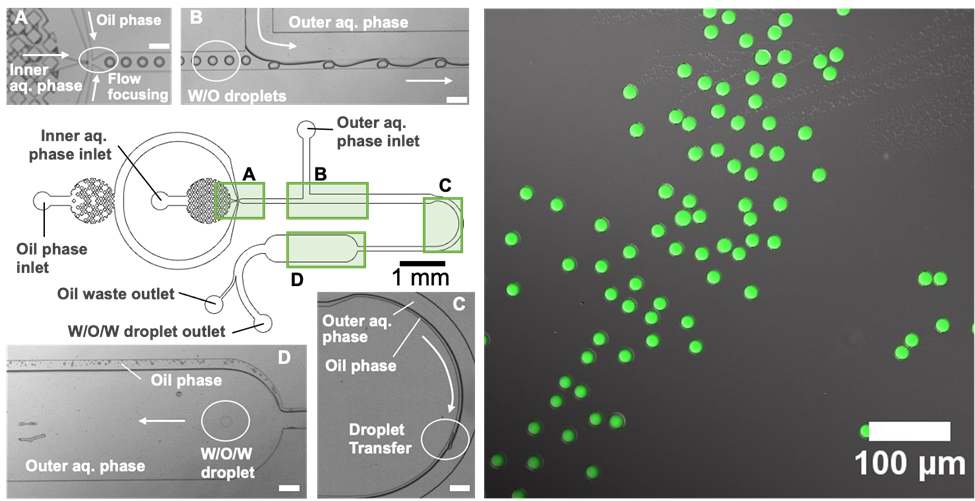
図1 マイクロ流体デバイスを用いたTGPRカプセルの作製。
<関連情報>
- https://www.chuo-u.ac.jp/aboutus/communication/press/2026/09/87966/
- https://onlinelibrary.wiley.com/doi/10.1002/dro2.70086
生物学的応用を目的とした、単分散性食品添加物ポリマーカプセルのマイクロ流体製造 Microfluidic production of monodisperse food-additive polymer capsules for biological applications
Yuki Gondo, Daiki Miyashita, Kazu Toyota, Mamiko Tsugane, Taro Toyota, Hiroaki Suzuki
Droplet Published: 02 September 2026
DOI:https://doi.org/10.1002/dro2.70086
Abstract
Water-in-oil (W/O) droplets are widely used as microcompartments for high-throughput biological assays, yet the continuous oil phase renders them incompatible with standard aqueous analytical instruments such as flow cytometers. To address this limitation, we present a robust microfluidic strategy for generating monodisperse water-in-oil-in-water (W/O/W) polymer capsules stabilized by food-grade amphiphile tetraglycerol polyricinoleate (TGPR). Using a polydimethylsiloxane microfluidic device that we previously developed to generate monodisperse giant lipid vesicles, we achieved reliable capsule formation via interfacial transfer. Optimization of the channel height and operating pressures facilitated spontaneous W/O droplet splitting during the transfer process, significantly increasing the generation frequency to approximately 160 Hz while maintaining high monodispersity. The resulting TGPR capsules exhibited superior long-term stability and thermal resistance compared to lipid vesicles. We demonstrated the utility of these capsules as robust bioreactors through successful in-capsule PCR amplification and the cultivation of Escherichia coli. These findings establish TGPR-stabilized capsules as a scalable, aqueous-compatible alternative to conventional W/O droplets for synthetic biology and high-throughput screening applications.