2026-10-12 中国科学院(CAS)
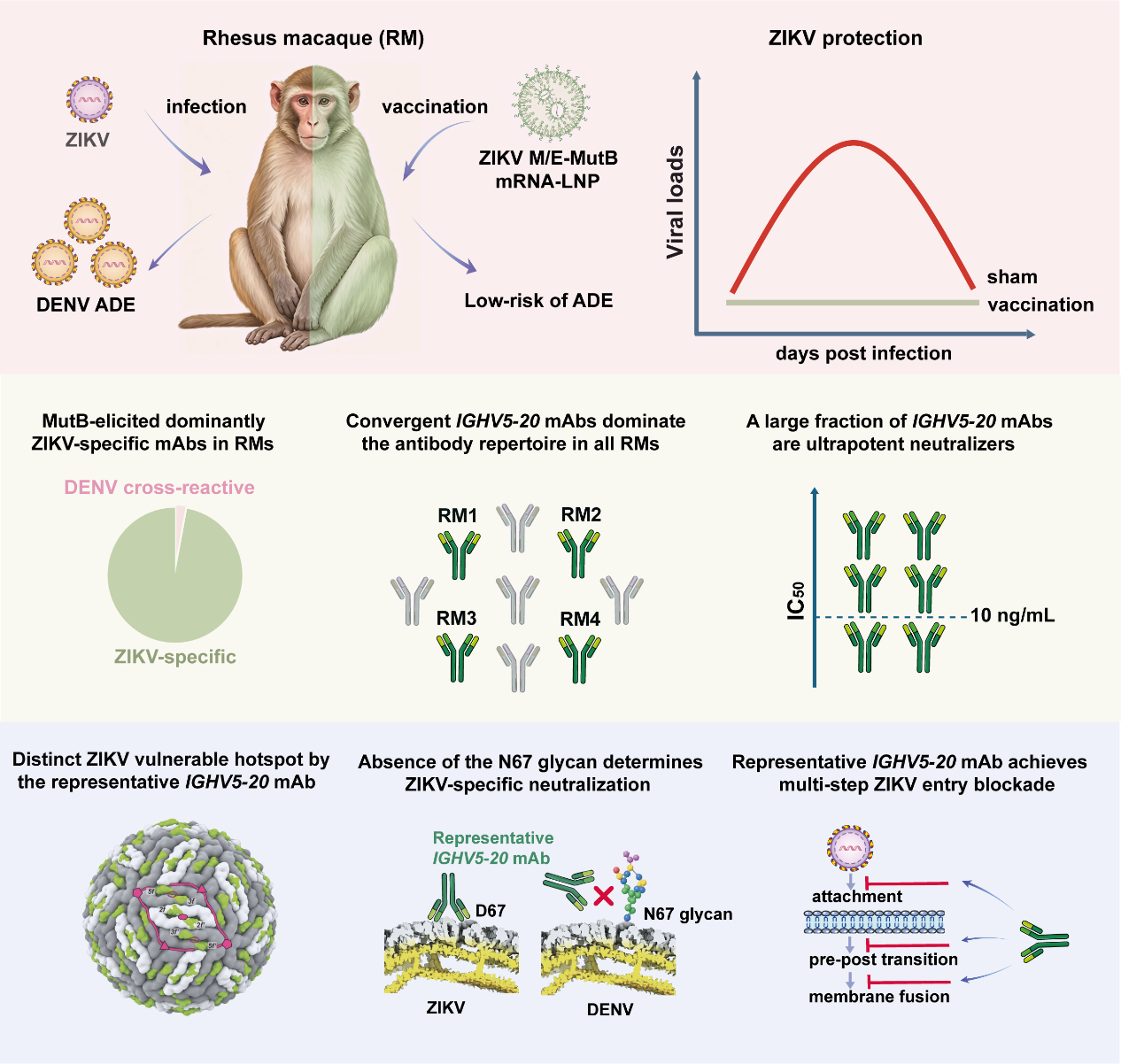
The fusion-loop-engineered Zika vaccine achieves protection in macaques and abolishes ADE risk. (Image by Prof. DAI Lianpan’s group)
<関連情報>
- https://english.cas.cn/newsroom/research-news/202610/t20261010_1201858.shtml
- https://www.cell.com/cell-reports-medicine/fulltext/S2666-3791(26)00508-2
融合ループ工学的に設計されたジカウイルスmRNAワクチンは、マカクザルにおいて収束的なB細胞免疫優位性を誘導し、防御とADEを切り離す Fusion-loop-engineered Zika mRNA vaccine elicits convergent B cell immunodominance to uncouple protection from ADE in macaques
Chenxi Yang ∙ Shuxin Guo ∙ Yaming Lu ∙ … ∙ Shuaiyao Lu ∙ George F. Gao ∙ Lianpan Dai
Cell Reports Medicine Published:October 7, 2026
DOI:https://doi.org/10.1016/j.xcrm.2026.103091
Highlights
- FL-engineered ZIKV-M/E mRNA vaccine protects primates with negligible DENV ADE
- Vaccine-induced B cells are mainly ZIKV specific and dominated by a convergent population
- Antibodies derived from this population target a distinct ZIKV vulnerable hotspot
- Absence of an N67 glycan on epitope determines ZIKV specificity of these antibodies
Summary
Antibody-dependent enhancement (ADE) remains a major hurdle for flavivirus vaccine development. Engineering the fusion loop (FL) represents a promising solution, yet validations restricted to murine models limit human translatability due to profound species divergence. Here, we provide a primate-level demonstration that FL-engineered Zika virus (ZIKV)-M/E mRNA vaccination protects against ZIKV challenge with negligible dengue virus (DENV) ADE. The vaccine-induced B cells are overwhelmingly ZIKV specific (>97%), dominated by a convergent population using a germline ortholog of human IGHV5-10-1, a gene preferentially recruited during natural human ZIKV infection. Antibodies derived from this population are highly potent and, mechanistically, achieve multi-stage viral entry blockade. Cryo-electron microscopy analysis reveals that these antibodies target a distinct, vulnerable hotspot on ZIKV. Notably, ZIKV specificity is dictated by the epitope residues D67-M68-A69, whereas a homologous DENV N67-linked glycan imposes steric shielding to preclude cross-reactivity. Our findings demonstrate that FL engineering uncouples protective immunity from ADE for safer human flavivirus vaccines.