2026-10-12 中国科学院(CAS)
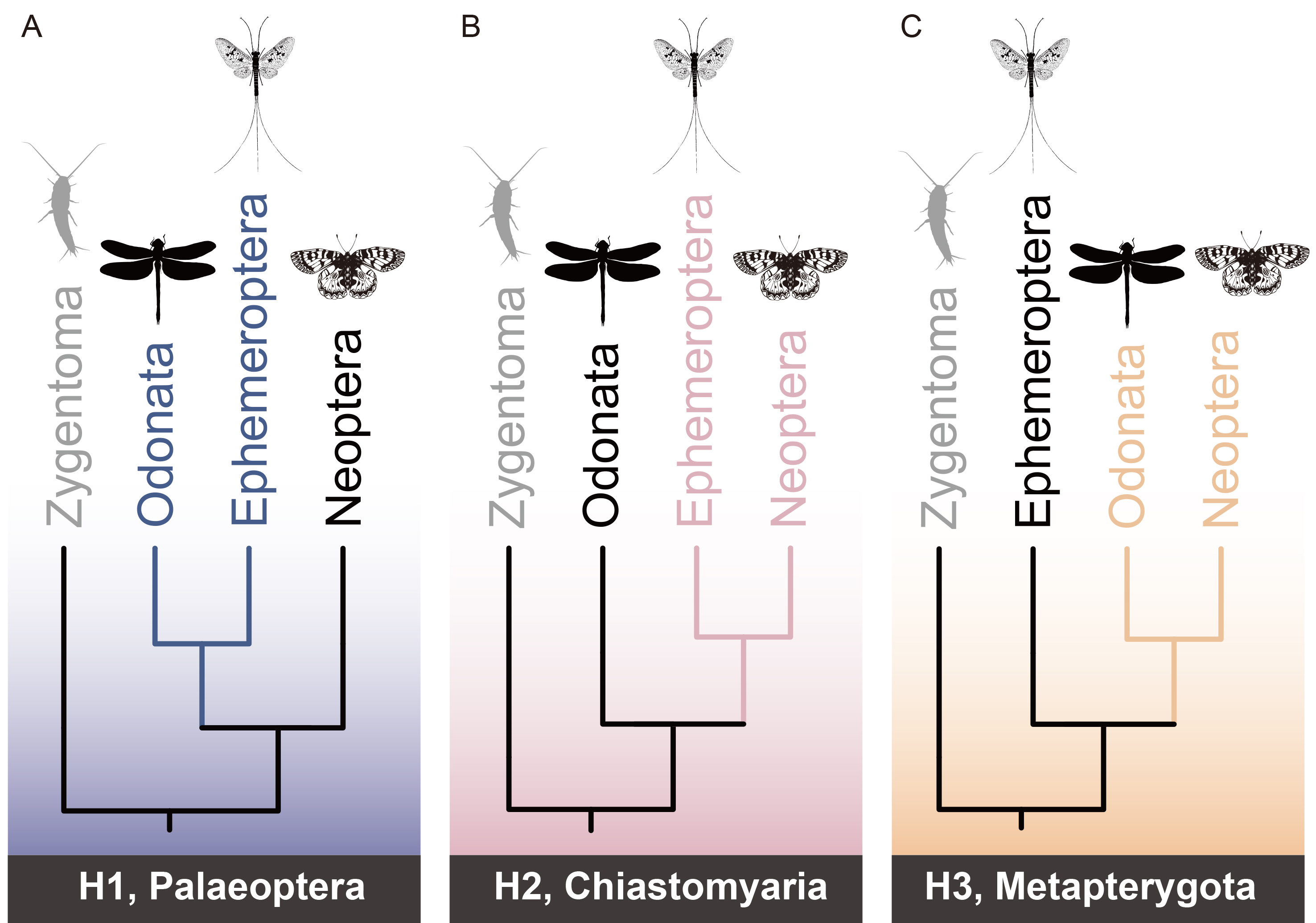
有翅昆虫の進化における初期分岐事象に関する3つの仮説。A. 古翅類仮説(H1):[[カゲロウ目 + トンボ目] + 新翅類];B. キアストミア類仮説(H2):[トンボ目 + [カゲロウ目 + 新翅類]];C. 後翅類仮説(H3):[カゲロウ目 + [トンボ目 + 新翅類]]。(画像提供:NIGPAS)
<関連情報>
- https://english.cas.cn/newsroom/research-news/202610/t20261010_1202180.shtml
- https://www.pnas.org/doi/10.1073/pnas.2614706123
系統ゲノム解析により、古翅類の単系統性が確認され、有翅昆虫の起源が明らかになった Phylogenomics confirms Palaeoptera monophyly and illuminates the origin of winged insects
Shiyu Du, Yehao Wang, Feng Zhang, +4 , and Chenyang Cai
Proceedings of the National Academy of Sciences Published:October 12, 2026
DOI:https://doi.org/10.1073/pnas.2614706123
Abstract
The origin and early radiation of winged insects (Pterygota) represent one of the most transformative events in terrestrial evolution, yet phylogenetic relationships among their basalmost lineages (Ephemeroptera, Odonata and Neoptera) continue to be a central debate within insect systematics. Here, we present the most taxonomically comprehensive phylogenomic analysis to date, leveraging genomic and transcriptomic data from 101 species, including 16 sequenced ephemeropteran genomes. Employing 1,367 universal single-copy orthologs across two supermatrices, we used concatenation- and coalescent-based frameworks under homogeneous and heterogeneous, and multispecies coalescent models. Our analyses support Palaeoptera monophyly. Although coalescent-based methods initially suggested a Chiastomyaria (Ephemeroptera + Neoptera) topology, subsequent signal dissection and topology tests confirm that the preponderance of genomic signal favors a monophyletic Palaeoptera. Furthermore, we identify incomplete lineage sorting and gene tree estimation error as the primary drivers of previous topological conflicts. Our molecular dating results point to an Early Devonian origin of crown-Pterygota, whereas crown-Palaeoptera first emerged in the Late Devonian. By reconciling molecular evidence with morphological synapomorphies, such as wing-base sclerite homologies, this study provides a coherent framework for the early evolution of winged insects, supports a single origin of wings, and identifies the neopteran wing-folding mechanism as a singular evolutionary innovation.