
2026-10-19 医薬基盤・健康・栄養研究所
<関連情報>
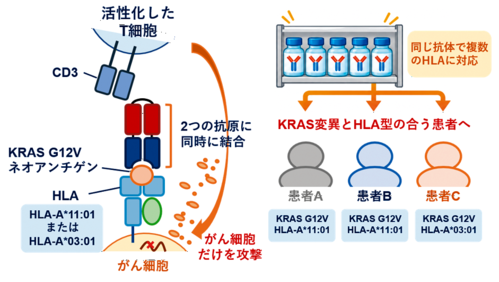
HLA-A*11:01とHLA-A*03:01の両方にまたがるKRAS G12Vネオアンチゲンを標的とするT細胞活性化二重特異性抗体の設計 Engineering T cell-engaging bispecific antibodies targeting KRAS G12V neoantigen across HLA-A*11:01 and HLA-A*03:01
Xiaojing Wu,Clara Effenberger,Yosuke Matsushita,Hiroki Tanaka,Yu Ishii,Suyong Re,…
Journal for ImmunoTherapy of Cancer Published:18 October 2026
DOI:10.1136/jitc-2026-016411
Abstract
Background T cells recognize tumor-specific neoantigens presented by human leukocyte antigen (HLA) molecules and can mediate potent antitumor immunity. However, most neoantigens are patient-specific, limiting their broad therapeutic applicability. KRAS G12V is a recurrent oncogenic mutation found in multiple cancer types and generates a shared neoantigen presented by HLA-A*11:01. We sought to develop a T cell-engaging bispecific antibody targeting this shared neoantigen.
Methods We screened a phage display library to identify a single-chain variable fragment (scFv) recognizing the KRAS G12V/HLA-A*11:01 complex. Candidate scFvs were characterized by ELISA and flow cytometry. A bispecific single-chain diabody incorporating a neoantigen-specific scFv and an anti-CD3 binding domain was generated and evaluated for antigen-specific T-cell activation, cytokine production, and cytotoxicity using peptide-pulsed target cells and KRAS G12V-positive cancer cell lines. Antitumor activity and safety were assessed in a human peripheral blood mononuclear cell (PBMC)-engrafted xenograft mouse model.
Results We identified scFv2, which selectively recognized the KRAS G12V/HLA-A*11:01 complex while discriminating against wild-type KRAS and other KRAS mutant peptides. Notably, scFv2 also recognized the KRAS G12V/HLA-A*03:01 complex. The resulting scFv2-based bispecific single-chain diabody (scDb2) induced robust antigen-specific T-cell activation, cytokine release and cytotoxicity against KRAS G12V-positive cancer cells expressing either HLA-A*11:01 or HLA-A*03:01, corresponding to an estimated patient coverage of ~5–6% in pancreatic cancer and ~2% in colorectal cancer. scDb2 recognized an endogenously processed and presented neoantigen, mediated cancer cell killing, and significantly suppressed tumor growth in vivo without overt toxicity.
Conclusion These findings identify a T cell-engaging bispecific antibody capable of recognizing KRAS G12V presented by both HLA-A*11:01 and HLA-A*03:01, providing a framework for expanding neoantigen-targeted immunotherapies across closely related HLA alleles, potentially broadening applicability across diverse patient populations.
