2026-10-22 琉球大学
<関連情報>
集団ゲノム解析によるメダカ野生集団で平衡淘汰が働く候補遺伝子座の特定 Population Genomic Analysis in Wild Medaka Populations: Identifying Candidate Loci for Balancing Selection
Shingo Fujimoto, Taijun Myosho, Hirozumi Kobayashi, Hiroaki Aoyama, Iki Murase, Bayu K. A. Sumarto, Mitsuharu Yagi, Taiga Kunishima …
Ecology and Evolution Published: 21 October 2026
DOI:https://doi.org/10.1002/ece3.74383
ABSTRACT
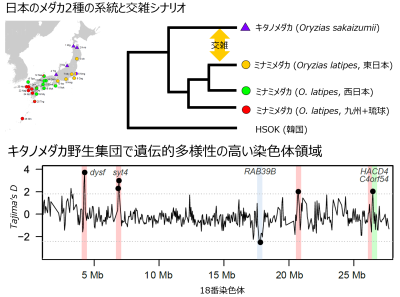
Sexual selection, defined as individual differences in reproductive success, can contribute to the maintenance of genetic polymorphisms through pleiotropic trade-offs between life history components. However, the extent to which sexual selection maintains genetic polymorphisms in wild populations remains unclear. Here, we explored genomic signatures of balancing selection and selective sweep in the northern medaka, Oryzias sakaizumii in Japan by performing whole-genome resequencing of wild individuals. In addition, we reevaluated the population genetic structure and admixture of Oryzias latipes and O. sakaizumii across the Japanese archipelago and identified genomic regions largely affected by introgression between the two species using Fd statistics to distinguish signatures of balancing selection from patterns potentially caused by introgression. Based on multiple population genetic statistics, we identified 18 candidate genomic regions showing signatures of selection. In particular, a 100-kb region at 6.85–6.95 Mb on chromosome 18 showed high genetic diversity that did not show outlier for the Fd statistics, indicating the extent of introgression in this region did not largely differ from the genome-wide average. This pattern suggests that balancing selection maintains genetic polymorphisms of the locus in O. sakaizumii. The overlap with a QTL for female mating behavior and the known molecular function of a gene within this candidate region for balancing selection suggest that sexual selection through female mate choice may contribute to the maintenance of polymorphism at this locus.