2026-10-22 コペンハーゲン大学(UCPH)
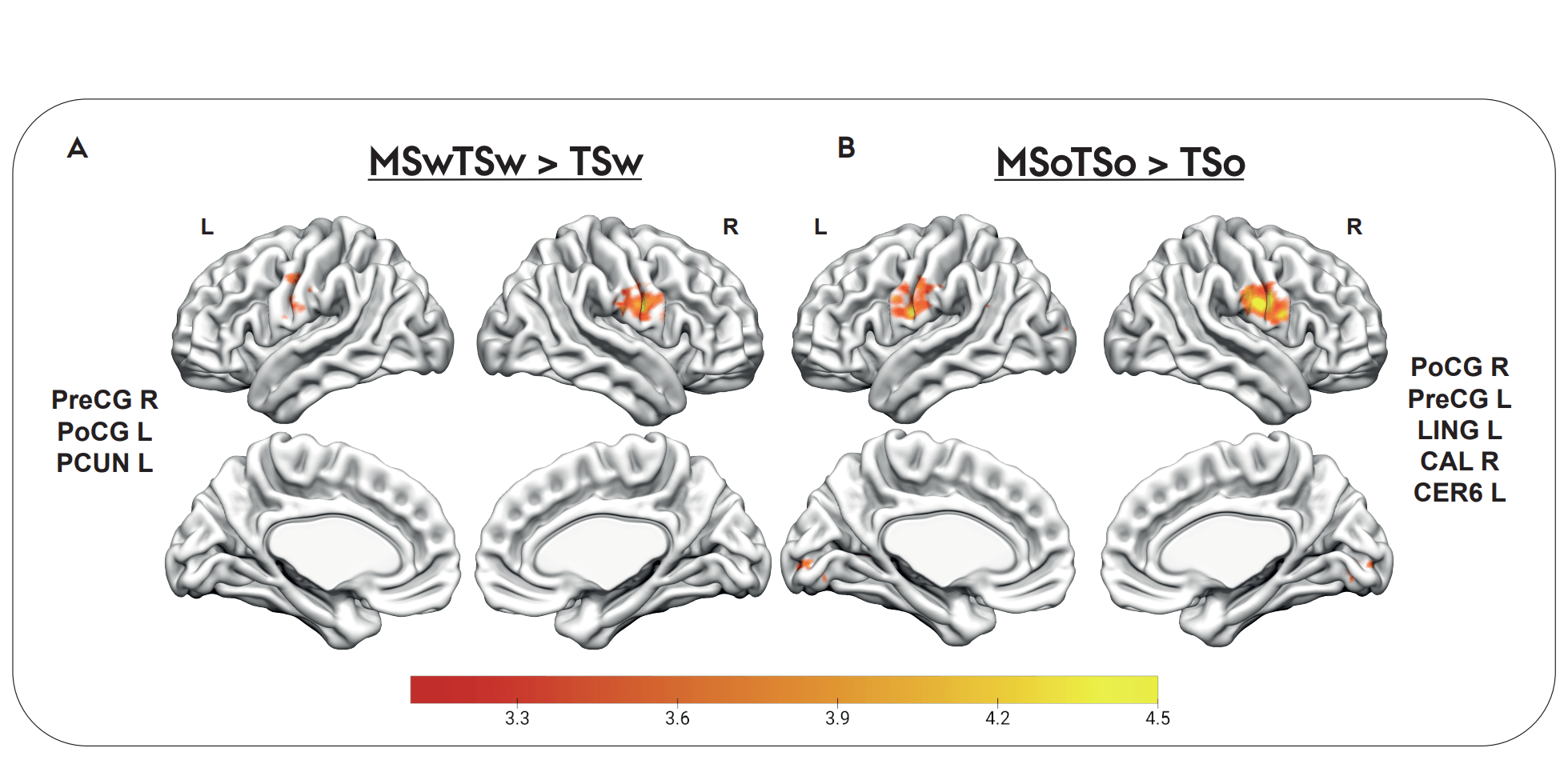
The figure shows what happens in the brain when taste is combined with music. On the left (A), sweet taste is paired with music associated with sweetness and compared with sweet taste alone. On the right (B), the same comparison is shown for sour taste. The yellow and orange areas indicate regions where the brain responds more strongly when music and taste are experienced together. These include areas involved in processing taste and sensory signals from the mouth. The findings show that what we hear can influence how the brain processes what we taste. Seeberg et al. (2026)
<関連情報>
- https://news.ku.dk/all_news/2026/10/music-can-enhance-the-flavour-of-your-food/
- https://www.nature.com/articles/s41598-026-53065-7
音楽と味覚の相互作用は、味覚および感覚運動に関わる脳活動を活性化させる Music–taste interactions enhance gustatory and sensorimotor brain activity
Alberte B. Seeberg, Ana Teresa Lourenço Queiroga, Patricia Alves Da Mota, Henrique Miguel Fernandes, Peter Vuust, Paul Smeets & Qian Janice Wang
Scientific Reports Published:11 June 2026
DOI:https://doi.org/10.1038/s41598-026-53065-7
Abstract
Eating is one of the most fundamental multisensory experiences, yet the neural mechanisms that integrate auditory and gustatory inputs in humans remain underexplored. This study examined how music influences the brain’s encoding of taste. We collected functional magnetic resonance imaging (fMRI) and behavioural data from 28 participants across three conditions: taste only, music only, and music–taste combinations. In the scanner, participants received sweet and sour aqueous solutions, accompanied by musical soundtracks composed to convey sweetness or sourness. In a behavioural session, participants rated each stimulus or combination for pleasantness, intensity, and sound–taste congruency. fMRI results revealed that sweet and sour music and taste stimuli engaged overlapping anatomical regions, particularly within peri-rolandic and medial prefrontal areas. Although voxel-wise conjunction did not identify suprathreshold overlap for sweet stimuli, regional co-localisation was observed in gustatory and reward-related regions, including the rolandic operculum, postcentral gyrus, and gyrus rectus. For sour stimuli, a small but significant voxel-wise conjunction emerged in the right postcentral gyrus. Crucially, concurrent music–taste stimulation elicited stronger activation in gustatory and sensorimotor cortices compared to taste alone, indicating multisensory enhancement. Direct contrasts between congruent and incongruent pairings revealed limited but selective congruency effects: when sweet taste was paired with congruent versus incongruent music, increased activation was observed in bilateral superior temporal gyri and rolandic operculum. Overall, these findings suggest that neural enhancement was primarily driven by the presence of simultaneous multimodal input, with additional modulation under specific congruent pairings. Behaviourally, participants perceived congruent music–taste pairings as more congruent and more pleasant, with modest trends toward increased taste intensity in the presence of music. These findings provide novel insight into the neural basis of sound–taste interactions and contribute to our understanding of how auditory cues can shape flavour perception through multisensory integration.