2026-10-28 埼玉大学
<関連情報>
- https://www.saitama-u.ac.jp/topics_archives/202610281000.html
- https://www.nature.com/articles/s41477-026-02438-x
ジベレリンシグナル伝達の合成活性化により、根の成長の空間的協調が明らかになる Synthetic activation of gibberellin signalling reveals spatial coordination of root growth
Yuichiro Yagami, Ryotaro Yamada, Yuuma Ishikawa, Eiki Meguro, Shuhei Kusano, Kenichiro Itami, Wolf B. Frommer, Shinya Hagihara & Masayoshi Nakamura
Nature Plants Published:22 October 2026
DOI:https://doi.org/10.1038/s41477-026-02438-x
Abstract
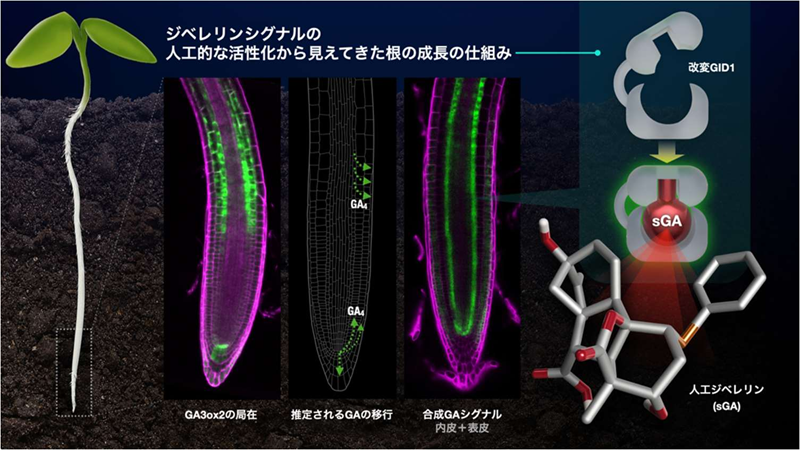
Gibberellins (GAs) influence cell division and elongation, profoundly shaping plant architecture and yield. GA perception occurs when bioactive GAs bind the receptor GID1, promoting DELLA degradation and activating transcriptional programs. While GA signalling in the root endodermis is essential for promoting root elongation, the contributions of other layers have remained unclear. Here we developed a synthetic GA (sGA) that exhibits little or no binding to endogenous GID1, together with a modified GID1 (mGID1) engineered to selectively recognize sGA, enabling cell-specific activation of GA signalling in vivo. Using this system in Arabidopsis, we demonstrate that coordinated action of GA signalling in the endodermis and epidermis is required for full root elongation. Moreover, the distal spatial distribution of GA signalling and GA biosynthetic enzymes supports a model in which bioactive GAs are transported from GA3ox-expressing tissues to the endodermis and epidermis to coordinate root elongation. The sGA–mGID1 system provides a versatile platform for spatially precise reprogramming of hormone signalling, enabling synthetic control of developmental processes such as root–shoot growth balance, thereby advancing applications in plant synthetic biology and sustainable crop improvement.