2026-09-15 東京大学
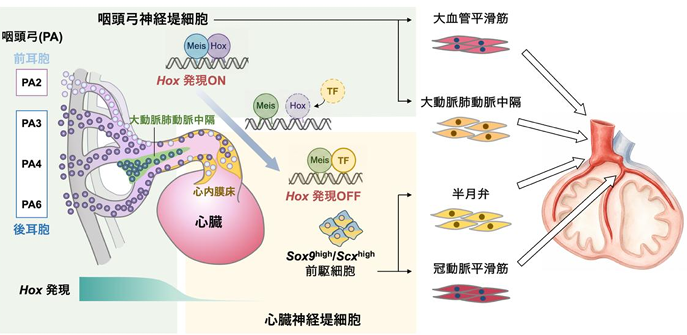
図1:心臓発生における神経堤細胞のHox依存的領域性の喪失と新たな分化能の獲得
<関連情報>
- https://www.u-tokyo.ac.jp/content/400296149.pdf
- https://link.springer.com/article/10.1038/s44318-026-00886-x
Hox / Meis依存性遺伝子制御遷移が心臓咽頭神経堤細胞の多様化の根底にある Hox/Meis-dependent gene-regulatory transition underlies cardiopharyngeal neural crest diversification
Akiyasu Iwase,Yasunobu Uchijima,Daiki Seya,Mayuko Kida,Hiroki Higashiyama,Kazuhiro Matsui,Akashi Taguchi,Yukihiro Harada,Yunce Wang,Shogo Yamamoto,Shiro Fukuda,Seitaro Nomura,Takahide Kohro,Chisa Shukunami,Haruhiko Akiyama,Masahide Seki,Akinori Kanai,Yutaka Suzuki,Teruhisa Kawamura,Osamu Nakagawa,Hiroto Katoh,Shumpei Ishikawa,Youichiro Wada,Hiroyuki Aburatani,… Hiroki Kurihara
The EMBO Journal Published: 15 September 2026
DOI:https://doi.org/10.1038/s44318-026-00886-x
Abstract
Neural crest cells (NCCs) are multipotent migratory cells essential for cardiac development, yet the lineage trajectories and gene regulatory networks underlying their differentiation in the cardiopharyngeal region remain unclear. Here, we integrate single-cell RNA-seq, spatial transcriptomics, and multiomic analyses to construct a comprehensive map of NCC lineages in developing mouse cardiopharyngeal tissues. We identify a transition from Hox-positive pharyngeal NCCs to Hox-negative intracardiac populations associated with the outflow tract cushion, accompanied by a shift in Meis transcription factor binding and gene-regulatory network architecture. By contrast, NCCs forming the aorticopulmonary septum and great vessel smooth muscle retain distinct Hox-codes. A Meis2–Sox9–Scx gene-regulatory network defines a skeletogenic progenitor-like intermediate state that gives rise to coronary artery smooth muscle and semilunar valves. Our findings suggest that the loss of Hox-dependent regional identity enables pharyngeal NCCs to acquire new fates upon entering the cardiac cushion, providing insight into the developmental origins of coronary and valvular calcification.