2025-08-27 東京農工大学
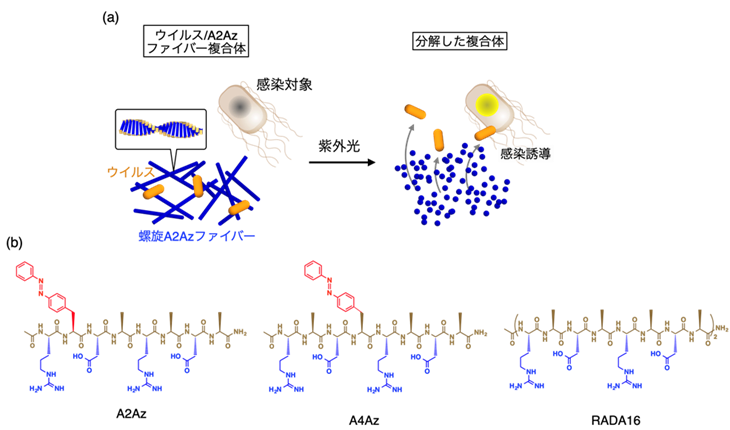
図1 (a) A2Az螺旋状ファイバーとウイルスの複合化と光による放出の概念図、(b) A2Az、A4Az、RADA16の分子構造。発表論文より転載(一部改変)。
A2Azファイバーは、その特徴的な螺旋構造からウイルスに対して強い相互作用を示し、複合体を形成する。その状態で紫外光を照射すると、ファイバーの脱重合によりウイルスが放出され、宿主であるE. coliへの遺伝子導入が促進される。
<関連情報>
- https://www.tuat.ac.jp/outline/disclosure/pressrelease/2025/20250827_02.html
- https://www.tuat.ac.jp/documents/tuat/outline/disclosure/pressrelease/2025/20250827_02.pdf
- https://onlinelibrary.wiley.com/doi/10.1002/anie.202508528
パターン形成と感染の多次元制御のためのウイルスと超分子ペプチドファイバーの光応答性ハイブリッド A Photoresponsive Hybrid of Viruses and Supramolecular Peptide Fibers for Multidimensional Control of Patterning and Infection
Dr. Atsuya Yaguchi, Prof. Noriyuki Uchida, Daiki Miura, Prof. Go Watanabe, Prof. Hirotsugu Hiramatsu, Prof. Itsuki Ajioka, Prof. Teruhiko Matsubara, Prof. Toshinori Sato, Chinbat Enkhzaya …
Angewandte Chemie International Edition Published: 25 August 2025
DOI:https://doi.org/10.1002/anie.202508528
Graphical Abstract
A hybrid of a bacteriophage virus and a helical supramolecular fiber, composed of an amphiphilic peptide containing an azobenzene group (A2Az), as a virus hybridizable self-assembling peptide is reported. The hybrid undergoes disassembly by photo-induced depolymerization of the A2Az fiber, which enables site-selective control of the adhesion and infection behaviors of the bacteriophage not only on 2D substrates but also in 3D hydrogel environments.

Abstract
Viruses are versatile colloidal materials in their biofunctions, monodispersed and periodic structures, and high surface designability. For expanding the applicability of virus-based materials, spatiotemporally controlled immobilization and dispersion of viruses with retained activity should be useful, though control of the dynamic nature of viruses hybridized with commonly used polymers has been difficult due to their strong interactions. Here, we report a self-assembling peptide (A2Az) enabling photo control of adhesion and dispersion of M13 bacteriophage virus (M13 phage) and successfully demonstrate patterning of localization and infection of the virus. A2Az is a cationic peptide with amphiphilicity that consists of eight amino acid residues containing a photo-responsive azobenzene group at the second position and self-assembles into a helical supramolecular fiber to form a hydrogel. The helical fibrillar morphology of A2Az exhibits strong interaction with M13 phage, allowing for immobilization not only on a two-dimensional surface but also in a three-dimensional hydrogel with suppression of infectivity. The A2Az fiber undergoes a light-triggered fiber-to-particle transition and releases the immobilized M13 phage with retained infectivity for the photo-controlled patterning of localization and infection. This approach has potential applicability to various virus-based biomaterials, such as structural materials and materials for photo-selective gene transfection to cells.