
2026-02-27 浙江大学(ZJU)
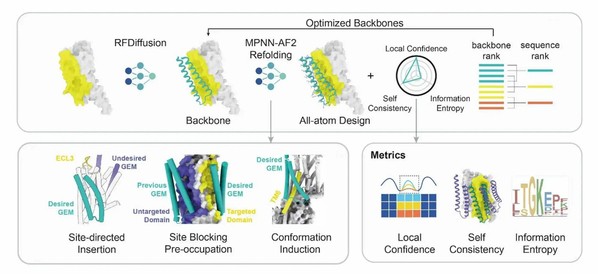
De novo Design of GEM.
<関連情報>
- https://www.zju.edu.cn/english/2026/0227/c19573a3135945/page.psp
- https://www.nature.com/articles/s41586-025-09957-1
GPCRエクソフレームモジュレーターの新規設計 De novo design of GPCR exoframe modulators
Shizhuo Cheng,Jia Guo,Yun-li Zhou,Xumei Luo,Gufang Zhang,Ya-zhi Zhang,Yixin Yang,Jiannan Xie,Ping Xu,Dan-dan Shen,Shaokun Zang,Huicui Yang,Xuechu Zhen,Min Zhang & Yan Zhang
Nature Published:16 February 2026
DOI:https://doi.org/10.1038/s41586-025-09957-1
Abstract
G-protein-coupled receptors (GPCRs) are important therapeutic targets and have been targeted mainly through their orthosteric site, where the endogenous agonist binds1. However, allosteric modulation has emerged as a promising and innovative strategy in the realm of GPCR drug discovery1. Here, drawing inspiration from the natural regulation of GPCRs by transmembrane proteins, we have developed GPCR exoframe modulators (GEMs), de novo designed proteins that specifically target the transmembrane domain of GPCRs. Utilizing a hallucination-like design approach, we crafted GEMs with three strategic structural prompts to achieve the desired binding modes. We selected the dopamine D1 receptor as a prototypical model and systematically investigated four GEMs. Structural studies and functional assays revealed that these GEMs bind to the transmembrane domains and function as diverse allosteric modulators, including agonist-positive allosteric modulator, negative allosteric modulator and biased allosteric modulator. The ago-PAM GEM restores the activity of various D1 receptor loss-of-function mutants, suggesting a promising therapeutic target for GPCR-related disorders. Our work introduces GEMs that target the transmembrane domain as potent agents for allosteric GPCR modulation and highlights the potential of deep learning-based approaches in the design of function-oriented membrane proteins.

