2026-03-17 東京農工大学
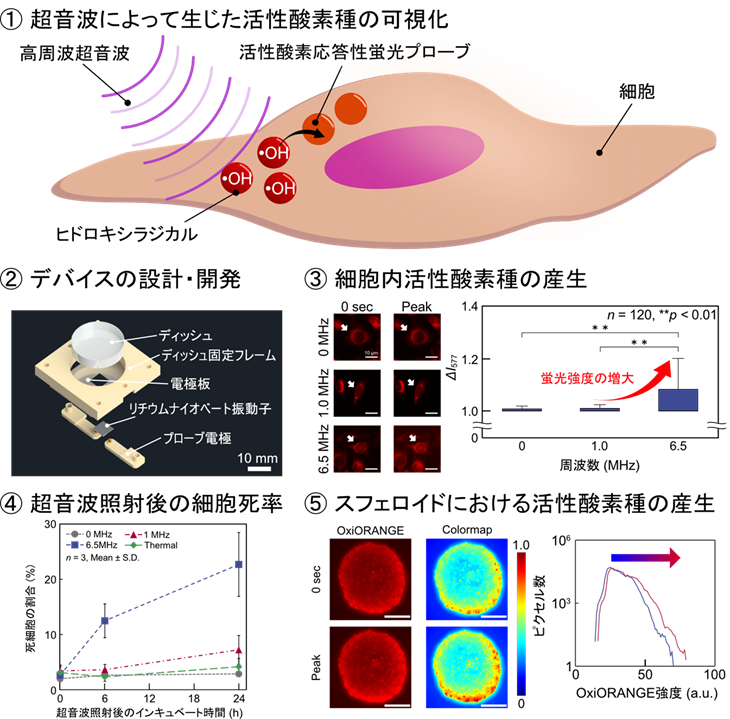
図1:本研究における高周波超音波を用いた細胞内活性酸素種の産生。①超音波によって生じた活性酸素種の可視化。②高周波超音波を照射するデバイスの構成。③超音波照射における周波数と細胞内の活性酸素種産生の関係。④超音波照射後のインキュベート時間に対する死細胞の割合。⑤スフェロイドにおける超音波由来の活性酸素種産生の時間変化(Fujishiro et al., Advanced Science 2026を基に作成)。
<関連情報>
- https://www.tuat.ac.jp/outline/disclosure/pressrelease/2025/20260317_01.html
- https://advanced.onlinelibrary.wiley.com/doi/10.1002/advs.202519582
厚み振動モードの高周波超音波によって誘発される細胞内活性酸素種の生成 Intracellular Reactive Oxygen Species Generation Induced by High-Frequency Ultrasound in Thickness Vibration Mode
Kotaro Fujishiro, Satoshi Okada, Filippo Rossi, Takahiro Kuchimaru, Yuta Kurashina
Advanced Science Published: 21 February 2026
DOI:https://doi.org/10.1002/advs.202519582
ABSTRACT
Reactive Oxygen Species (ROS), which play a critical role in cellular signaling pathways, are one of the chemical products caused by ultrasound irradiation. In general, ROS generation has been ignored in terms of high-frequency ultrasound (>5 MHz) due to the limitation of cavitation induction. However, does high-frequency ultrasound not affect the production of ROS in cells? Here, we propose comparing ROS in solution and intracellular ROS generation by ultrasound at high frequency (6.5 MHz) and at a common frequency (1 MHz) in medical ultrasound applications, thereby elucidating the capabilities of high-frequency ultrasound on cells by ROS production. We discovered that 6.5 MHz ultrasound, as irradiated by a lithium niobate transducer, generates intracellular ROS more than conventional 1.0 MHz ultrasound. The phenomenon of ROS production by high-frequency ultrasound having high spatial resolution demonstrated the possibility that ultrasound is capable of effectively generating intracellular ROS at the cellular level.