2026-04-02 国立精神・神経医療研究センター
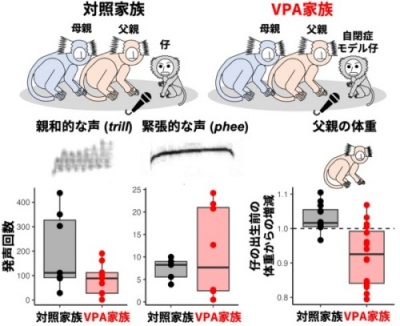
図1. 自閉症モデル仔を育てる家族(VPA家族)の音声コミュニケーション
<関連情報>
- https://www.ncnp.go.jp/topics/detail.php?@uid=bY6rnqnXRHi4sh8K
- https://www.sciencedirect.com/science/article/pii/S2589004226007947
バルプロ酸誘発性自閉症モデルにおけるマーモセットの親族関係を示す音声ダイナミクスの変化 Altered kinship vocal dynamics in marmosets with valproic acid-induced model of autism
Koki Mimura, Keiko Nakagaki, Hirofumi Morishita, Noritaka Ichinohe
iScience Available online: 20 March 2026
DOI:https://doi.org/10.1016/j.isci.2026.115419
Highlights
- Prenatal VPA exposure alters kinship-level vocal dynamics in marmoset families
- VPA families show increased isolation calls and reduced affiliative vocal patterns
- Attenuated vocal maturation reflects ASD-relevant communication alterations
Summary
Autism spectrum disorder (ASD) involves social communication impairments and repetitive behaviors. Language abnormalities in ASD, such as echolalia and idiosyncratic speech, heighten caregiver stress and affect communication dynamics within the kinship system. However, the influence of ASD-related traits on family-level interactions remains poorly understood in animal models. Here, we established an ASD model in common marmoset via prenatal valproic acid (VPA) exposure, and analyzed 28,418 kinship vocalizations from VPA-exposed and unexposed (UE) pups with their parents. VPA families exhibited increased isolation calls, decreased affiliative calls, disrupted repetition patterns, and reduced developmental maturations. These alternations intensified after weaning and correlated with parental weight loss, suggesting heightened caregiver stress. VPA pups also displayed premature locomotion independence, indicating broader social disruptions. Our findings highlight VPA marmosets as valuable models for investigating ASD-like traits at both individual and kinship levels, with kinship vocalizations serving as potential non-invasive biomarkers of ASD-related communication impairments and family stress.