2026-04-22 フランス国立科学研究センター(CNRS)
<関連情報>
- https://www.cnrs.fr/en/press/pancreatic-cancer-antibody-proves-itself-early-clinical-trial
- https://www.nature.com/articles/s41586-026-10436-4
Netrin1阻害は膵臓癌における化学療法耐性を軽減する Netrin1 blockade alleviates resistance to chemotherapy in pancreatic cancer
Gael Roth,Pascal Artru,Olivier Bouche,Nicolas Williet,Julien Ghelfi,Anthony Turpin,Astrid Lievre,Jean-Frédéric Blanc,Camille Evrard,Jean-Baptiste Bachet,Pauline Parent,Marc Manceau,Matthieu Roustit,Anna Borowik,Victoire Granger,Aurélie Durand,Christelle d’Engremont,Edouard Girard,Mircea Chirica,Nicolas Braissand,Nicolas Rama,Eugénie Modolo,Hector Hernandez-Vargas,Elise Georges,… Patrick Mehlen
Nature Published:22 April 2026
DOI:https://doi.org/10.1038/s41586-026-10436-4
Abstract
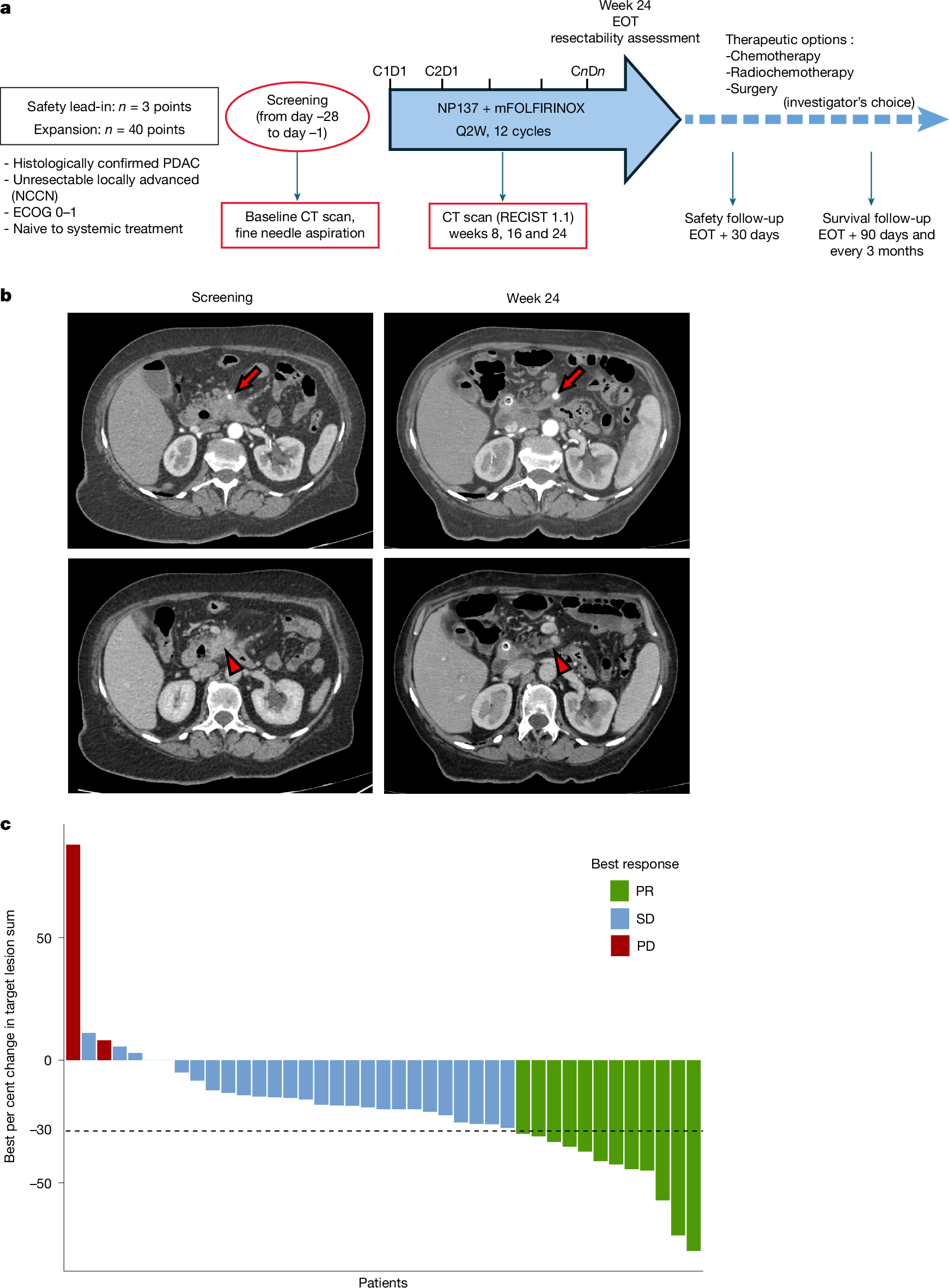
Netrin1, a developmental cue, is a master regulator of tumour epithelial-to-mesenchymal transition (EMT)1, a mechanism that is known to drive resistance to chemotherapy2. A netrin1 antibody (NP137)3 has been shown to inhibit tumour EMT in preclinical1 and clinical4 settings. In animal models of pancreatic cancer, netrin1 and its receptor neogenin have been shown to promote tumour progression5, EMT5 and metastasis6. Here we report the results of a phase 1b study that assesses the combination of NP137 with modified FOLFIRINOX (mFOLFIRINOX) in first line patients with locally advanced pancreatic cancer (ClinicalTrials.gov: NCT05546853). Forty-three patients were enrolled and received mFOLFIRINOX plus NP137 every other week for up to 12 cycles. NP137 was well tolerated. Median progression-free survival (PFS) was 10.85 months (95% confidence interval, 10.03–15.61) and median overall survival was 16.43 months (95% confidence interval, 12.75–non-reached), with 21 patients remaining alive at the time of data cut-off. Post-therapy conversion surgery occurred in 23% of patients. Laser capture microdissection was performed on pre-therapeutic biopsies and surgical specimens. Microbulk RNA sequencing confirmed that the main pathway that was down-regulated with the combination of mFOLFIRINOX plus NP137 was EMT. Moreover, survival outcomes were extended for patients with tumour cells that expressed high levels of the netrin1 receptor neogenin—median PFS 15.65 months in neogenin-high versus 10.22 months in neogenin low. Our results support the idea that netrin1 blockade alleviates resistance to chemotherapy by inhibiting EMT, particularly in neogenin-high pancreatic cancer.