2026-04-28 東北大学
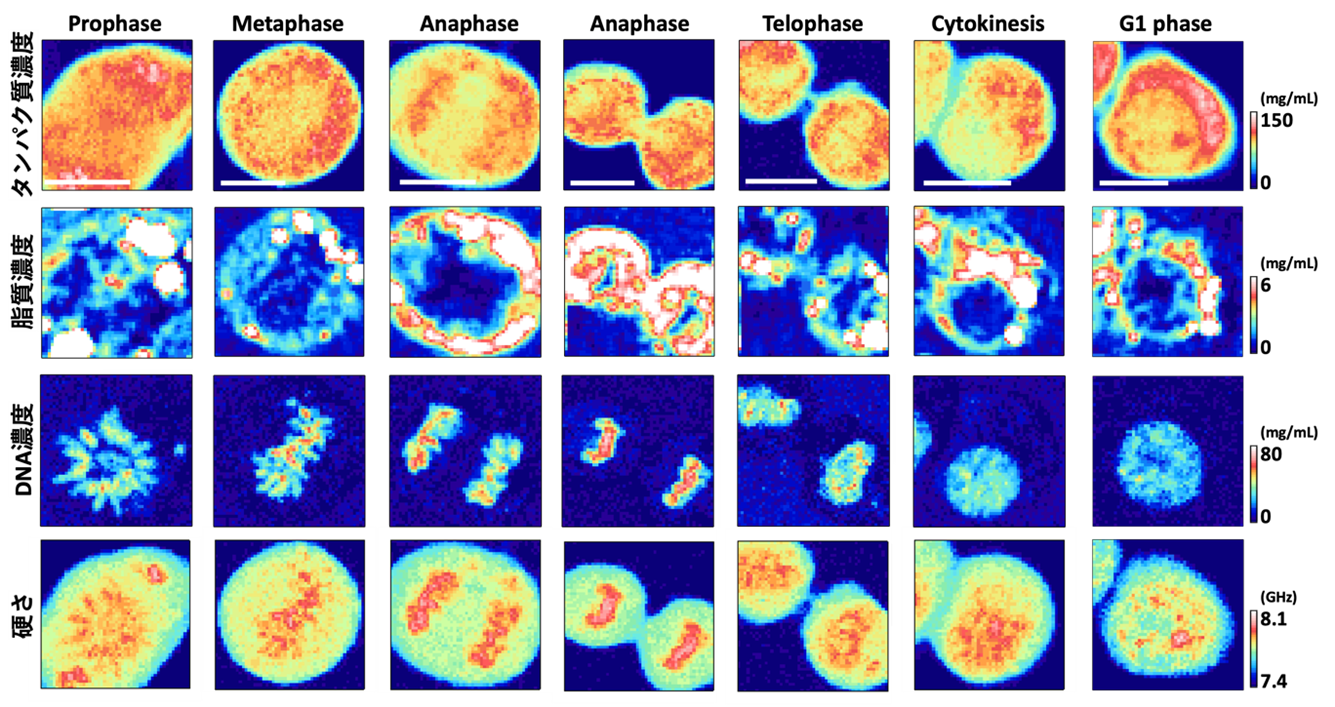
図1. 有糸分裂中の細胞の生体分子濃度と硬さの空間分布。ラマン散乱から各生体分子の濃度分布を、ブリルアン散乱から硬さの分布を可視化している。分裂過程においてDNAを高濃度に含む、”硬い”染色体構造を形成し、その後2つの娘細胞へ分配される過程を定量的に可視化している。
<関連情報>
- https://www.tohoku.ac.jp/japanese/2026/04/press20260428-01-DNA.html
- https://pubs.acs.org/doi/10.1021/jacsau.6c00082
定量ラマンブリルアン顕微鏡法によって明らかになった、脂質がヘテロクロマチン凝縮に寄与する Lipids Contribute to Heterochromatin Condensation Revealed by Quantitative Raman–Brillouin Microscopy
Masato Machida,Shinji Kajimoto,Ren Shibuya,Mayu Isono,Mai Watabe,Yukako Oma,Kayo Hibino,Kentaro Fujii,Masaki Okumura,Masahiko Harata,Atsushi Shibata,and Takakazu Nakabayashi
JACS Au Published: April 24, 2026
DOI:https://doi.org/10.1021/jacsau.6c00082
Abstract
Chromatin is a dynamic, higher-order structure that compacts genomic DNA within the nucleus and regulates genome organization and accessibility. Chromatin is broadly classified into transcriptionally inert heterochromatin and active euchromatin based on their condensation states; however, the molecular basis underlying this condensation difference remains unresolved. In this study, we show that phosphatidylcholine-type lipid molecules are associated with heterochromatin in living cells and contribute to its physical condensation. Using label-free Raman–Brillouin microscopy, we simultaneously mapped molecular concentrations and high-frequency viscoelastic properties in a living cell at subcellular resolution. Raman imaging revealed that lipid molecules are selectively enriched in heterochromatin, and their local concentrations are correlated with the mechanical response of heterochromatin. These lipids were absent from mitotic chromosomes and reappeared in DNA-rich regions during the early G1 phase, indicating that lipid incorporation is a regulated step in the formation of heterochromatin. These results expand the molecular view of chromatin and demonstrate how simultaneous Raman–Brillouin imaging can link chemical constituents with the mechanical properties of a cell.