2026-05-13 産業技術総合研究所
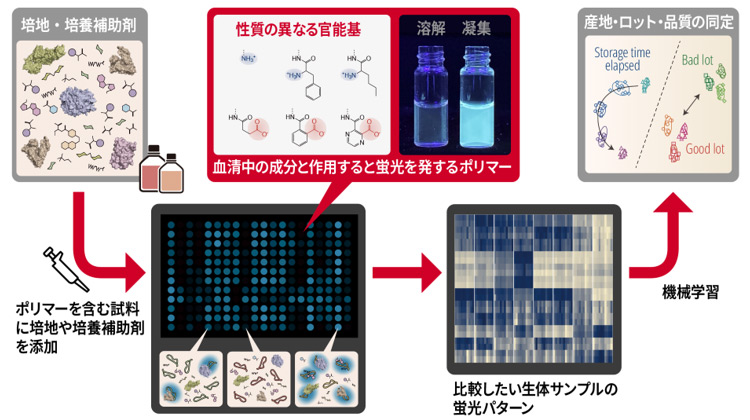
※原論文の図を引用・改変したものを使用しています。
<関連情報>
- https://www.aist.go.jp/aist_j/press_release/pr2026/pr20260513/pr20260513.html
- https://pubs.rsc.org/en/content/articlelanding/2026/sc/d6sc00383d
細胞製造における複雑な培養培地の包括的な品質評価のための指紋ベースのポリマーセンシングプラットフォーム A fingerprint-based polymeric sensing platform for comprehensive quality assessment of complex culture media in cell manufacturing
Shunsuke Tomita,Kumi Morikawa,Naoshi Kojima,Sayaka Ishihara, Hiroyuki Kusada,Hideyuki Tamaki and Ryoji Kurita
Chemical Science Published:17 Apr 2026
DOI:https://doi.org/10.1039/D6SC00383D
Abstract
The rapid advancement of cell manufacturing across biotechnology, regenerative medicine, and cellular agriculture is driving a growing demand for simple and reliable analytical tools to ensure the consistent quality of complex culture media, whether derived from natural or synthetic sources. Here, we present a hypothesis-free, data-driven polymeric sensing platform that employs an array of synthetic polymer probes to generate fluorescence-response fingerprints, enabling the statistical detection of subtle compositional differences in complex biological mixtures. This approach, based on charged block-copolymers conjugated with aggregation-induced-emission (AIE) fluorophores, successfully distinguishes 16 animal sera and identifies differences in serum origin, lot, and storage conditions through rapid and simple fluorescence measurements. Unexpectedly, the resulting response fingerprints also encode phylogenetically informative signals among animal species. Furthermore, the platform detects quality variations in serum-free supplements for stem-cell culture and naturally derived supplements used for microbial culture, including subtle compositional changes undetectable by standard cell-culture assays. As this fingerprint-based strategy does not require prior assumptions about which specific components are important, it can be flexibly adapted to a diverse array of supplement types and quality control needs. Overall, this versatile sensing platform provides a robust and reproducible framework for proactive quality assessment in cell manufacturing, supporting the reliable production of cell-based products.