2026-05-14 富山大学
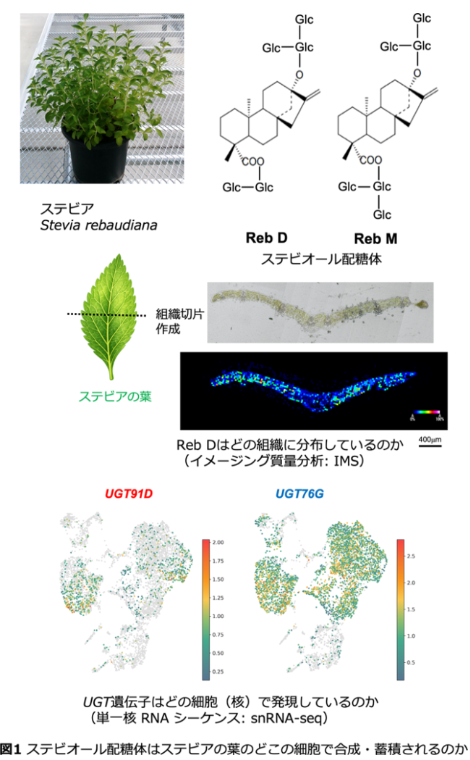
富山大学和漢医薬学総合研究所、サントリービバレッジ&フード、理化学研究所などの共同研究グループは、天然甘味料植物ステビアの全ゲノム配列を解読し、「甘さ」を決定する遺伝的仕組みを明らかにした。研究では、甘味成分ステビオール配糖体の合成に関与する糖転移酵素(UGT76G遺伝子群)に着目し、葉内の特定細胞でこれら遺伝子が発現していることを確認した。また、マルチオミクス解析により、糖転移酵素遺伝子群の配列や発現パターンの違いが、系統ごとの甘味成分組成や含量差を生み、「甘さ」の違いにつながることを示した。さらに、葉内で甘味成分が蓄積する部位も可視化された。近年、糖分摂取過多による健康リスクへの関心が高まる中、ステビア由来天然甘味料の需要は拡大しており、本成果は高品質甘味料開発や、目的に応じた甘味成分制御型ステビア品種育成の基盤技術となることが期待される。
<関連情報>
- https://www.u-toyama.ac.jp/news-press/133926/
- https://nph.onlinelibrary.wiley.com/doi/10.1111/nph.71191
ステビア・レバウディアナにおけるステビオール配糖体合成のマルチオミクス解析により、UGT76G遺伝子のハプロタイプに関連した特殊化が明らかになった Multi-omics dissection of steviol glycoside synthesis reveals haplotype-linked specialization of UGT76G genes in Stevia rebaudiana
Tsubasa Shoji, Atsushi Fukushima, Hatsune Morinaka, Hiroki Takagi, Yu Nakashima, Tetsuya Mori, Ayako Kawamura, Dongbo Shi, Kotaro Torii, Akira Iwase, Noriko Takeda-Kamiya
New Phytologist Published: 13 May 2026
DOI:https://doi.org/10.1111/nph.71191
Summary
- Steviol glycosides (SGs), intensely sweet diterpenoids found in Stevia rebaudiana (stevia), exhibit natural variation in composition that influences taste quality and commercial value. However, the genetic and cellular mechanisms underlying this variation remain poorly understood. We aimed to uncover how haplotype-level diversity and cell-type-specific gene expression contribute to SG profile diversity in stevia.
- We generated a chromosome-scale reference genome and conducted integrative multi-omics analyses combining haplotype-resolved population genomics, single-nucleus RNA sequencing, and imaging mass spectrometry. These approaches were applied to a diverse panel of breeding lines and a segregating population to associate genetic variants with SG composition and expression patterns.
- We identified a physically linked cluster of UGT76G glycosyltransferase genes whose structural and regulatory polymorphisms drive major differences in SG composition. Restricted expression of UGT91D4 to specific subsets of mesophyll and epidermal cells further constrained the biosynthesis of high-value SGs, such as rebaudioside D and rebaudioside M. Functional divergence among UGT76G paralogs was supported by sequence, expression, and structural modeling data.
- Our findings define a multi-allelic and spatially coordinated regulatory architecture underlying SG biosynthesis in stevia. These insights provide a foundation for haplotype-guided breeding and metabolic engineering strategies aimed at improving stevia sweetness quality and yield.