2026-05-20 中国科学院(CAS)
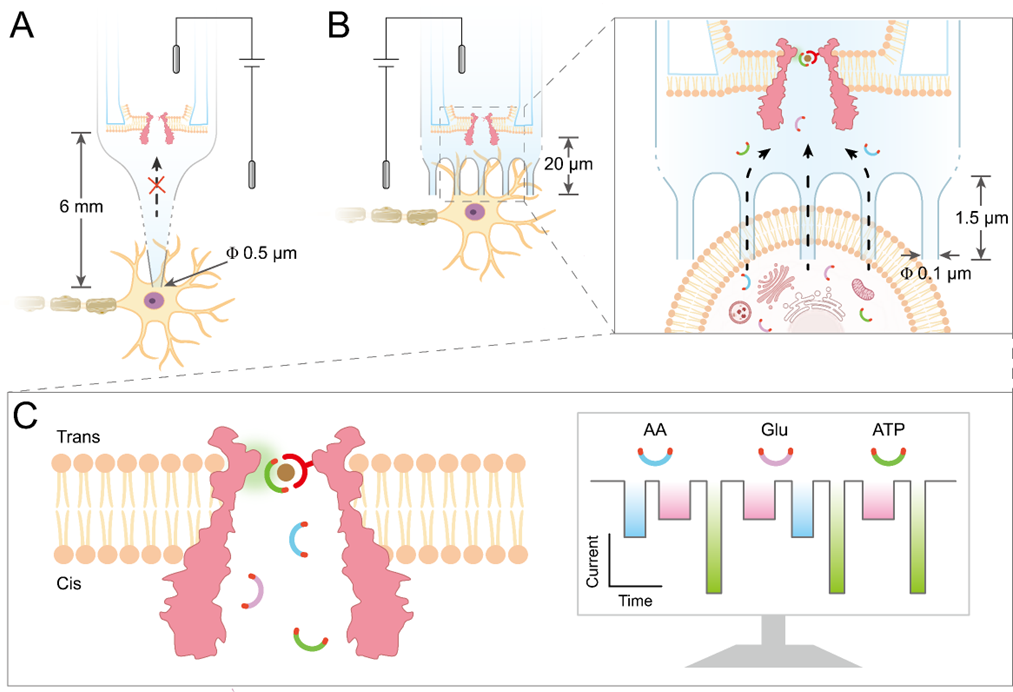
Nanopore probes for in situ molecular extraction and detection in single cells (Image by HUANG Xiaobin)
<関連情報>
- https://english.cas.cn/newsroom/research-news/202605/t20260519_1159611.shtml
- https://www.pnas.org/doi/10.1073/pnas.2529161123
ナノポアプローブを用いた単一生細胞における細胞内活動のin situリアルタイムモニタリング In situ and real-time monitoring of intracellular activities in single live cells using a nanopore probe
Xiaobin Huang, Ziyi Li, Yanling Huang, +2 , and Hai-Chen Wu
Proceedings of the National Academy of Sciences Published:April 15, 2026
DOI:https://doi.org/10.1073/pnas.2529161123
Significance
Understanding molecular dynamics within single live cells is essential for elucidating how cellular heterogeneity drives physiology and disease. Yet, existing single-cell methods cannot continuously track multiple biomolecules in situ and in real time. We developed a nanopore probe that integrates a nanostraw extraction interface with a protein nanopore sensor, enabling label-free, quantitative, and multiplexed detection of intracellular molecules in single living neurons. Using this system, we simultaneously monitored glutamate, ascorbic acid, and adenosine triphosphatedynamics during ischemic stress, revealing molecular events underlying neuronal edema. This study represents a successful application of nanopore sensing inside live cells, offering a powerful platform for probing cellular processes and disease mechanisms at single-molecule resolution.
Abstract
Monitoring molecular activities within single live cells is vital for understanding cellular differentiation, senescence, heterogeneity, and disease progression. However, conventional single-cell analyses often rely on micromanipulation or extraction followed by downstream measurements, which cannot capture in situ real-time dynamics. Fluorescent labeling and electrochemical methods provide temporal resolution but face limitations in labeling, substrate scope, and multiplexing. Here, we present a nanopore probe that enables real-time, multiplexed monitoring of intracellular activities in single live cells. The device integrates an aluminum oxide nanostraw membrane for molecular extraction and a glass nanopore membrane for single-channel electrical detection. Using a hippocampal neuron model of ischemia-hypoxia, we simultaneously tracked dynamic changes in intracellular glutamate, ascorbic acid, and adenosine triphosphate—three key molecules involved in oxygen-glucose deprivation-induced neuronal edema. Our findings establish this nanopore probe as a powerful platform for real-time, label-free molecular profiling at the single-cell level, opening opportunities for studying disease mechanisms and therapeutic responses.