2026-05-26 東北大学
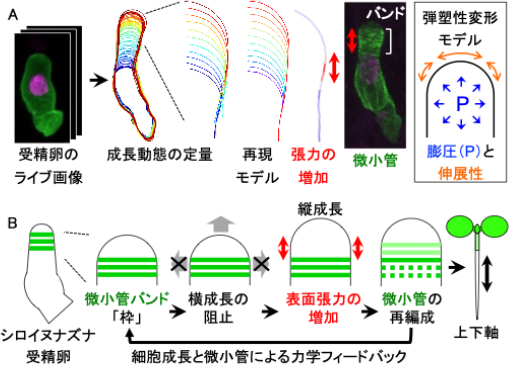
図1. (A)本研究で行った解析の流れ。(B)本研究で見出した細胞成長と微小管による力学フィードバックの模式図。
<関連情報>
- https://www.tohoku.ac.jp/japanese/2026/05/press20260526-02-zygote.html
- https://www.nature.com/articles/s41467-026-72280-4
表面張力の時間的変化が、シロイヌナズナ接合子の微小管組織化と正確な非対称分裂を誘導する Temporal changes in surface tension guide microtubule organization and accurate asymmetric division of Arabidopsis zygotes
Zichen Kang,Sakumi Nakagawa,Hikari Matsumoto,Yukitaka Ishimoto,Tomonobu Nonoyama,Yuga Hanaki,Satoru Tsugawa & Minako Ueda
Nature Communications Published:22 May 2026
DOI:https://doi.org/10.1038/s41467-026-72280-4 Unedited version
Abstract
In most plants, the zygote divides asymmetrically to define the body axis. In Arabidopsis thaliana, the zygote undergoes polar cell elongation with maintaining a transverse band of cortical microtubules (MTs) at the growing cell tip. How the MT band is maintained at the actively renewing tip and whether it contributes to the asymmetric zygote division remain elusive. By combining live-cell imaging, mechanical simulation, and various perturbation analyses, we demonstrate a bidirectionally interactive feedback in which the MT band forms a mechanical frame to support polar zygote elongation, and this growth increases the calculated surface tension at the zygote tip to induce MT band formation. Furthermore, after zygote elongation is complete, the MT band guides another MT band, preprophase band, to determine the accurate cell division site. Therefore, the MT band is maintained via mechanical feedback with polar cell growth, ensuring the proper asymmetric cell division of the zygote.