2026-05-26 北海道大学
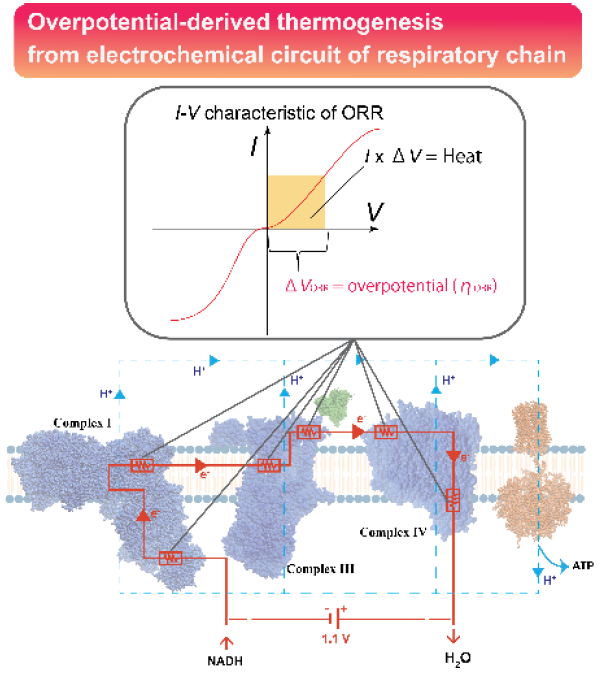
ミトコンドリア呼吸鎖の電子移動を電気回路としてモデル化し、過電圧によるエネルギー損失が熱産生の起源となることを示した図。主な発熱部位は複合体IVである。
<関連情報>
- https://www.hokudai.ac.jp/news/2026/05/post-2295.html
- https://pubs.rsc.org/en/content/articlelanding/2026/sc/d5sc06693j
ミトコンドリアの過電圧駆動型熱産生は酵素的酸素還元反応が支配する Enzymatic oxygen reduction dominates overpotential-driven thermogenesis in mitochondria
Nuning Anugrah Putri Namari,Mo Yan,Junji Nakamura and Kotaro Takeyasu
Chemical Science Published:30 Mar 2026
DOI:https://doi.org/10.1039/D5SC06693J
Abstract
Understanding how chemical energy dissipates as heat in non-equilibrium redox systems is a fundamental problem in physical chemistry. While this phenomenon is well described in electrochemical systems such as fuel cells, its role in biological enzymatic systems remains underexplored. Mitochondrial thermogenesis has long been attributed to proton leakage, which correlates with heat generation but lacks a clearly defined physical mechanism. In fact, catalytic reactions—whether occurring on inorganic electrodes or in biological enzymes—inevitably require finite overpotentials, and quantifying these losses demands a site-specific kinetic descriptor. To this end, we introduce the electron transfer frequency (ETF), directly analogous to the turnover frequency (TOF) in heterogeneous catalysis, as a means to analyze enzymatic electron-transfer processes at the single-site level. Using ETF as the central descriptor, we develop a chemistry-based framework that models intracellular heat production as the dissipation of Gibbs free energy through enzymatic overpotentials in the mitochondrial electron transport chain, analogous to Joule heat in fuel cells. By treating each respiratory complex as a resistive kinetic step and calibrating the model with experimentally measured electrochemical parameters, we estimate that 45–71% of respiration energy is dissipated as heat. Among these, complex IV alone contributes over 70% of the total dissipation, establishing it as the primary thermogenic site. This framework reproduces reported heat-to-respiration ratios across diverse cell types and demonstrates that overpotential dissipation, rather than proton leakage, represents a major and quantifiable pathway of heat generation. More broadly, it shows that analytical principles of electrocatalysis can be predictively extended to biological redox systems, establishing a common physical chemistry basis for energy dissipation in both.