2026-06-26 東京大学,科学技術振興機構
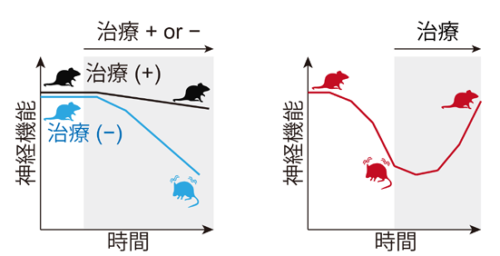
図1:これまでの研究と今回の研究の比較
<関連情報>
- https://www.jst.go.jp/pr/announce/20260626/index.html
- https://www.jst.go.jp/pr/announce/20260626/pdf/20260626.pdf
- https://www.science.org/doi/10.1126/science.ady3911
マウスモデルにおけるオートファジーの可逆的抑制は神経細胞の回復力を明らかにする Reversible suppression of autophagy in a mouse model reveals neuronal resilience
Tomoya Eguchi, Manabu Abe, Takuya Tomita, Hideaki Morishita, […] , and Noboru Mizushima
Science Published:25 Jun 2026
DOI:https://doi.org/10.1126/science.ady3911
Editor’s summary
Neurons must continuously remove cellular debris to avoid a decline in health and function. However, it has remained unclear how well neurons can recover once such waste has accumulated. Eguchi et al. addressed this question by developing a mouse model in which autophagy, a key intracellular degradation system, can be reversibly switched on and off. They found that suppressing autophagy led to the accumulation of protein aggregates in neurons as well as motor and cognitive dysfunction. Restoring autophagy largely reversed these changes. These results demonstrate the resilience of neurons and highlight the importance of cellular cleanup systems in both maintaining and restoring brain function. —Stella M. Hurtley
Abstract
Impairments in intracellular quality-control mechanisms, including autophagy, affect neuronal integrity and function. Despite numerous studies aimed at slowing neuronal deterioration, it remains unclear whether neuronal function and intracellular quality can be restored once impaired. We developed a mouse model in which autophagy could be rapidly and reversibly regulated to investigate the reversibility of such defects. Suppressing autophagy led to proteome and transcriptome changes, inclusion body accumulation, and axonal swelling, all of which were largely ameliorated after autophagy restoration. Consistent with these cellular abnormalities, autophagy suppression induced motor and cognitive dysfunction, which was also reversed on autophagy restoration. Our findings elucidate the potential resilience of neuronal function and quality enabled by intracellular clearance.