2026-06-26 名古屋工業大学,科学技術振興機構,東京大学,京都大学,関西医科大学,東北大学
名
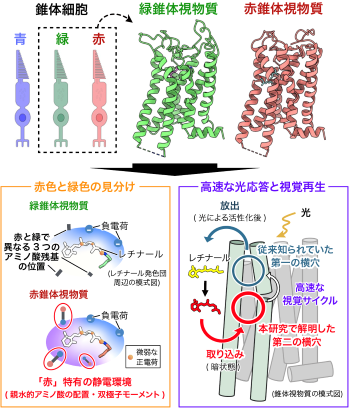
本研究成果の概要
<関連情報>
- https://www.nitech.ac.jp/news/press/2026/14082.html
- https://www.science.org/doi/10.1126/science.adz3996
錐体視覚色素におけるスペクトル調整と網膜交換に関する構造的知見 Structural insights into spectral tuning and retinal exchange in cone visual pigments
Sayaka Ohashi, Kota Katayama, Asato Kojima, Xuchun Yang, […] , and Hideki Kandori
Science Published:25 Jun 2026
DOI:https://doi.org/10.1126/science.adz3996
Abstract
Color vision in catarrhine primates relies on red-, green-, and blue-sensitive cone pigments that share an 11-cis-retinal chromophore but differ in absorption maxima. Red and green pigments arose by recent gene duplication and differ at only a few residues. Here, we report cryo–electron microscopy structures of red and green cone pigments from the cynomolgus macaque (Macaca fascicularis) integrated with low-temperature vibrational spectroscopy and quantum mechanical and molecular mechanical modeling. The red-green spectral shift is dominated by threonine 285, the hydroxyl dipole of which modulates chromophore electrostatics, whereas steric effects appear modest. We also identified membrane-facing lateral openings in cone pigments but not in inactive rhodopsin. Comparisons with active-state structures suggest activation-dependent gating, and mutational and spectroscopic analyses support a role for this opening in retinal uptake and rapid pigment regeneration.