2026-07-06 京都大学
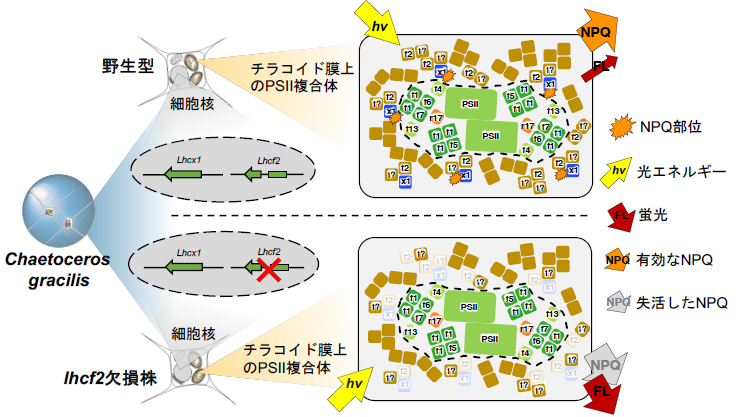
研究成果の概要図。(図はXing Jian がMS PowerPointにて作成)
<関連情報>
- https://www.kyoto-u.ac.jp/ja/research-news/2026-07-06-0
- https://www.pnas.org/doi/10.1073/pnas.2601782123
珪藻 Chaetoceros gracilis において周辺アンテナタンパク質Lhcf2は⾮光化学的消光とLhcx1蓄 積に必須である Lhcf2 in the peripheral antenna is essential for nonphotochemical quenching and Lhcx1 accumulation in the diatom Chaetoceros gracilis
Jian Xing, Minoru Kumazawa, and Kentaro Ifuku
Proceedings of the National Academy of Sciences Published:June 30, 2026
DOI:https://doi.org/10.1073/pnas.2601782123
Abstract
Photosynthetic organisms must continuously balance efficient light harvesting with protection against excess excitation energy, a challenge met by nonphotochemical quenching (NPQ). Although the molecular components involved in NPQ have been extensively studied, how the essential energy-quenching site is assembled remains poorly understood, particularly in marine diatoms. Here, we show that in the centric diatom Chaetoceros gracilis, which belongs to one of the most abundant and diverse genera in marine phytoplankton, the light-harvesting complex (LHC) protein Lhcf2 is required for energy-dependent quenching (qE). Targeted knockout of Lhcf2 abolished qE by preventing the stable accumulation of Lhcx1, a core component of the NPQ effectors in this species. Lhcf2 localizes to the peripheral antenna system and associates with Lhcx1 in a higher-order complex suggested by biochemical and functional analyses. In contrast, other established NPQ-related factors, including the trans-thylakoid proton gradient and the accumulation of diatoxanthin, were not affected by the loss of Lhcf2. These results identify a non-Lhcx-type LHC protein as an essential structural component for qE-NPQ and establish a general design principle for the cooperative assembly of photoprotective energy-quenching sites in eukaryotic photosynthesis, with implications for marine carbon fixation.