2026-07-27 デューク大学(Duke)
<関連情報>
- https://pratt.duke.edu/news/ai-gut-microbiome-therapies/
- https://www.nature.com/articles/s41589-026-02272-4
能動学習による食物繊維と腸内細菌叢の相互作用の設計 Designing fiber–gut microbiome interactions with active learning
Bryce M. Connors,Jaron Thompson,Manasi Subhash Gangan,Nick Quinn-Bohmann,Sean M. Gibbons,Job Grant,Alejandro Castellanos-Sanchez,Jessica R. McCann,John F. Rawls & Ophelia S. Venturelli
Nature Chemical Biology Published:27 July 2026
DOI:https://doi.org/10.1038/s41589-026-02272-4
Abstract
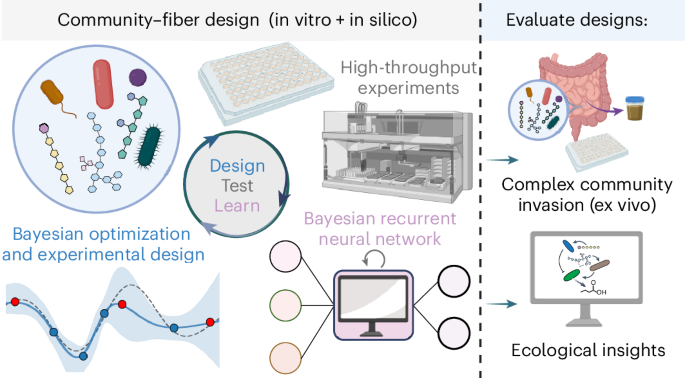
Identifying synergies between dietary fibers and beneficial bacteria holds promise for precision interventions that optimize gut health, yet these interactions remain largely unexplored. Here we integrate machine learning, Bayesian optimization and high-throughput community construction to investigate how dietary fibers shape health-relevant functions of human gut microbial communities. To efficiently navigate the landscape of fiber–microbiome interactions, we implemented a design–test–learn cycle to identify fiber–species combinations that maximize a multiobjective function capturing beneficial community properties. Our model-guided approach revealed a highly butyrogenic and robust ecological motif characterized by the copresence of inulin, Bacteroides uniformis and Anaerostipes caccae and a higher-order interaction with Prevotella copri. Human fecal communities invaded with model-designed species–fiber combinations displayed predictable gut-beneficial outputs. In sum, we demonstrate a framework for designing synthetic microbial communities with desired functions in response to key nutrients.