2026-07-29 ノースウェスタン大学
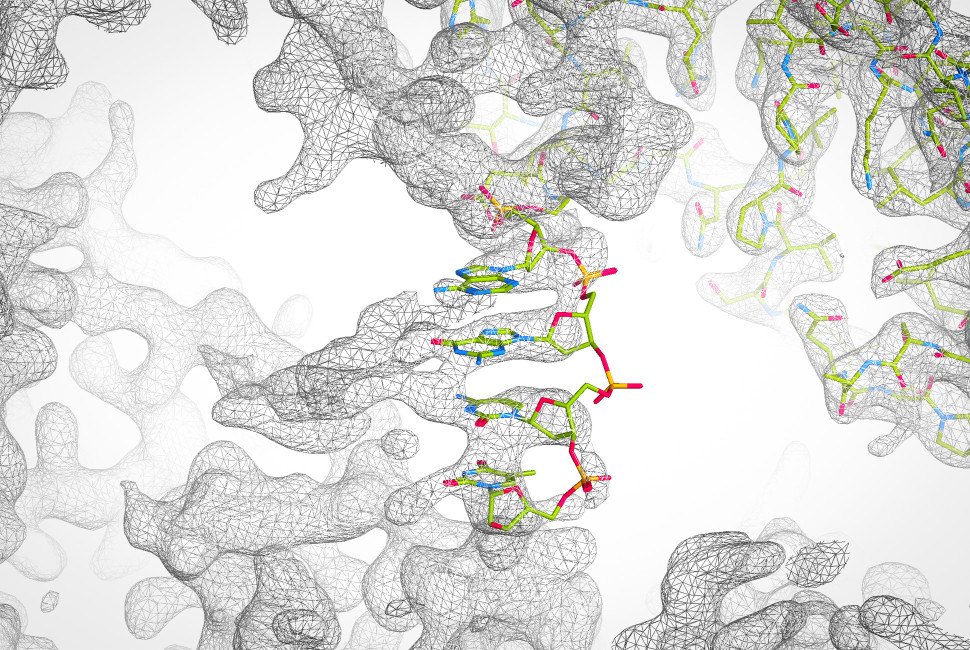
In the new study, Chad Mirkin’s team attached short DNA strands to each protein. Image courtesy of the Mirkin Research Group
<関連情報>
- https://news.northwestern.edu/stories/2026/07/flexible-dna-transforms-protein-crystallization
- https://www.science.org/doi/10.1126/sciadv.aeh2948
- https://www.nature.com/articles/382607a0
DNAを用いて設計された、回折に適した超柔軟なタンパク質単結晶 Diffraction-quality, ultraflexible protein single crystals engineered with DNA
Zhenyu Han and Chad A. Mirkin
Science Advances Published:29 Jul 2026
DOI:https://doi.org/10.1126/sciadv.aeh2948
Abstract
DNA-functionalized colloidal nanoparticles assemble through flexible, nanoscale DNA hybridization interactions that limit atomic-level structural order. Here, we report a valence-centric strategy that enables DNA-bonded, protein single crystals with unconventional mechanical properties. An octameric enzyme, glutarate L-2-hydroxylase, was site- and number-selectively conjugated with eight self-complementary single-stranded DNA, yielding octavalent molecular bonds. The resulting conjugate assembled into the designed body-centered tetragonal crystals that diffracted to 1.42- to 2.61-angstrom resolution, with contacts mediated by B-form DNA helices spanning 17 to 25 angstroms. Increasing oligonucleotide length induces anisotropic lattice expansion while preserving atomic periodicity, even with partial DNA occupancy. Mechanistic studies suggest that the dynamic motion of unhybridized DNA facilitates crystallization, analogous to fluctuating electron clouds in atomic bonding. Compared with native protein crystals, DNA-hybridized crystals are 23-fold softer. These results challenge the assumption that flexibility is incompatible with structural order and establish a programmable framework for biomolecular crystallization and nanomaterials engineering with atomic precision.
ナノ粒子をマクロな材料へと合理的に組み立てるためのDNAベースの手法 A DNA-based method for rationally assembling nanoparticles into macroscopic materials
Chad A. Mirkin,Robert L. Letsinger,Robert C. Mucic & James J. Storhoff
Nature Accepted24 June 1996
DOI:https://doi.org/10.1038/382607a0
Abstract
COLLOIDAL particles of metals and semiconductors have potentially useful optical, optoelectronic and material properties1–4 that derive from their small (nanoscopic) size. These properties might lead to applications including chemical sensors, spectro-scopic enhancers, quantum dot and nanostructure fabrication, and microimaging methods2–4. A great deal of control can now be exercised over the chemical composition, size and polydis-persity1,2 of colloidal particles, and many methods have been developed for assembling them into useful aggregates and materials. Here we describe a method for assembling colloidal gold nanoparticles rationally and reversibly into macroscopic aggregates. The method involves attaching to the surfaces of two batches of 13-nm gold particles non-complementary DNA oligo-nucleotides capped with thiol groups, which bind to gold. When we add to the solution an oligonucleotide duplex with ‘sticky ends’ that are complementary to the two grafted sequences, the nanoparticles self-assemble into aggregates. This assembly process can be reversed by thermal denaturation. This strategy should now make it possible to tailor the optical, electronic and structural properties of the colloidal aggregates by using the specificity of DNA interactions to direct the interactions between particles of different size and composition.