2026-08-18 東北大学
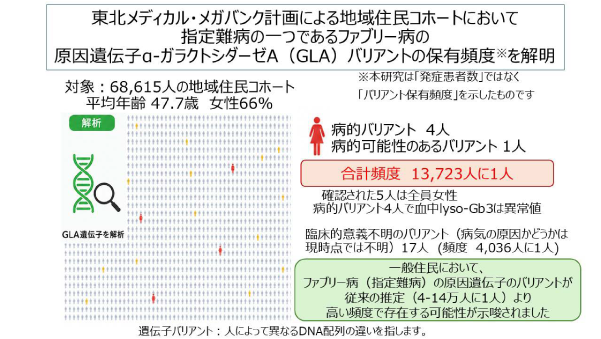
図1. 研究概要
<関連情報>
- https://www.tohoku.ac.jp/japanese/2026/08/press20260818-06-gla.html
- https://www.sciencedirect.com/science/article/pii/S2949774426010009
ゲノムシーケンス解析により、日本におけるファブリー病原因変異の蔓延状況が明らかに:東北メディカルメガバンクからのエビデンス Genome Sequencing Reveals the Prevalence of Fabry Disease–Causing Variants in Japan: Evidence from the Tohoku Medical Megabank
Kai Susukita MD, Kotaro Nochioka MD PhD MPH, Masato Takase PhD, Saori Yamamoto MD PhD, Kazuki Kumada PhD, Hideaki Suzuki MD PhD, Kinuko Ohneda MD PhD, Kenichi Noguchi PhD, Yoko Izumi MD PhD, Soichi Ogishima PhD, Naoki Nakaya PhD, Yoshikatsu Eto MD PhD, Atushi Hozawa MD PhD, Satoshi Yasuda MD PhD
Genetics in Medicine Open Available online: 7 August 2026
DOI:https://doi.org/10.1016/j.gimo.2026.104490
Introduction
Fabry disease (FD) is a rare X-linked lysosomal storage disorder caused by pathogenic variants in the GLA gene, resulting in impaired activity of α-galactosidase A.(1) This enzymatic deficiency leads to progressive accumulation of globotriaosylceramide and related metabolites in vascular endothelial cells and multiple organs, including the heart, kidneys, and nervous system.(1, 2) The prevalence of Fabry disease in the general population has traditionally been estimated at approximately 1 in 40,000–140,000 individuals.(1, 3) Although newborn screening programs, particularly in Taiwan, have provided well-defined estimates of Fabry disease prevalence and have revealed a substantially higher frequency of late-onset variants, population-based genomic data remain limited in other Asian populations. (1, 4) This study aimed to determine the prevalence of Fabry disease–causing variants in genome sequencing data from a community-based cohort in the Tohoku Medical Megabank, Japan.