2026-08-20 北海道大学,科学技術振興機構
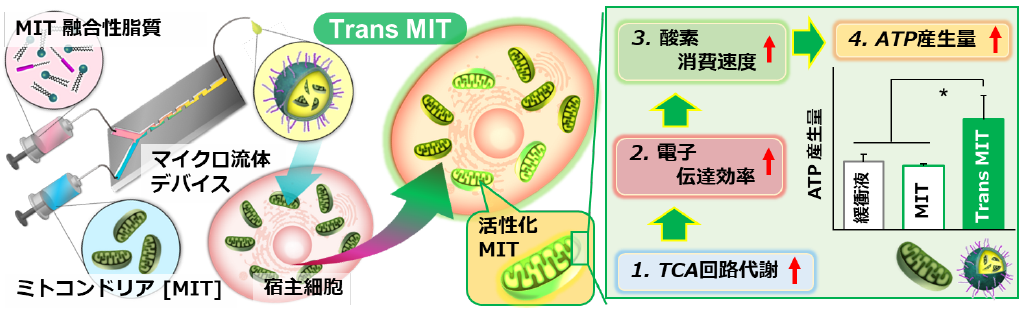
Trans MITによるミトコンドリア成分送達と細胞機能活性化の概念図
<関連情報>
- https://www.hokudai.ac.jp/news/2026/08/post-2407.html
- https://www.sciencedirect.com/science/article/pii/S2590049826002274
ミトコンドリア成分で細胞機能を制御する脂質ナノカプセル「Trans MIT」の開発 Trans MIT: microfluidically fabricated lipid nano capsules for robust intracellular delivery of mitochondria-derived components and metabolic enhancement
Yuma Yamada, Momo Ito, Mitsue Hibino, Daisuke Sasaki, Masahiro Shiraishi, Jiro Abe, Mai Kanai, Masatoshi Maeki, Manabu Tokeshi, Yoshihiro Ohta, Hideyoshi Harashima
Materials Today Advances Available online: 19 August 2026
DOI:https://doi.org/10.1016/j.mtadv.2026.100912
Abstract
Intracellular transfer of intact mitochondria has primarily been reported as a therapeutic approach to restore cellular function; however, controlled intracellular delivery of mitochondria-derived components remains largely unexplored, particularly from a materials and manufacturing perspective. Here, we present Trans MIT, microfluidically fabricated lipid nano capsules designed for robust intracellular delivery of mitochondria-derived components. Trans MIT is constructed based on the MITO-Porter concept, a lipid-based delivery platform originally developed for mitochondrial targeting via membrane fusion, and is manufactured using a controlled microfluidic (iLiNP) process to ensure reproducible particle properties. In cultured cells, treatment with Trans MIT resulted in consistent enhancement of cellular bioenergetic function, as evidenced by increased basal and maximal oxygen consumption rates and elevated ATP levels. Metabolomic analyses further revealed activation of the tricarboxylic acid cycle and oxidative phosphorylation pathways following Trans MIT delivery. In this system, cellular uptake is mediated by an octaarginine (R8) moiety, while the fusogenic lipid envelope facilitates mitochondrial targeting of mitochondria-derived components without inducing overt cytotoxicity. The microfluidic fabrication process further supports batch-to-batch consistency and scalability. In contrast to direct addition of isolated mitochondria under specific experimental conditions, Trans MIT provides a materials-driven platform for controlled intracellular delivery of mitochondria-derived components. These results establish Trans MIT as a robust lipid nano capsule system for organelle-inspired nanomedicine and materials-based modulation of cellular metabolism.