2026-08-26 中国科学院(CAS)
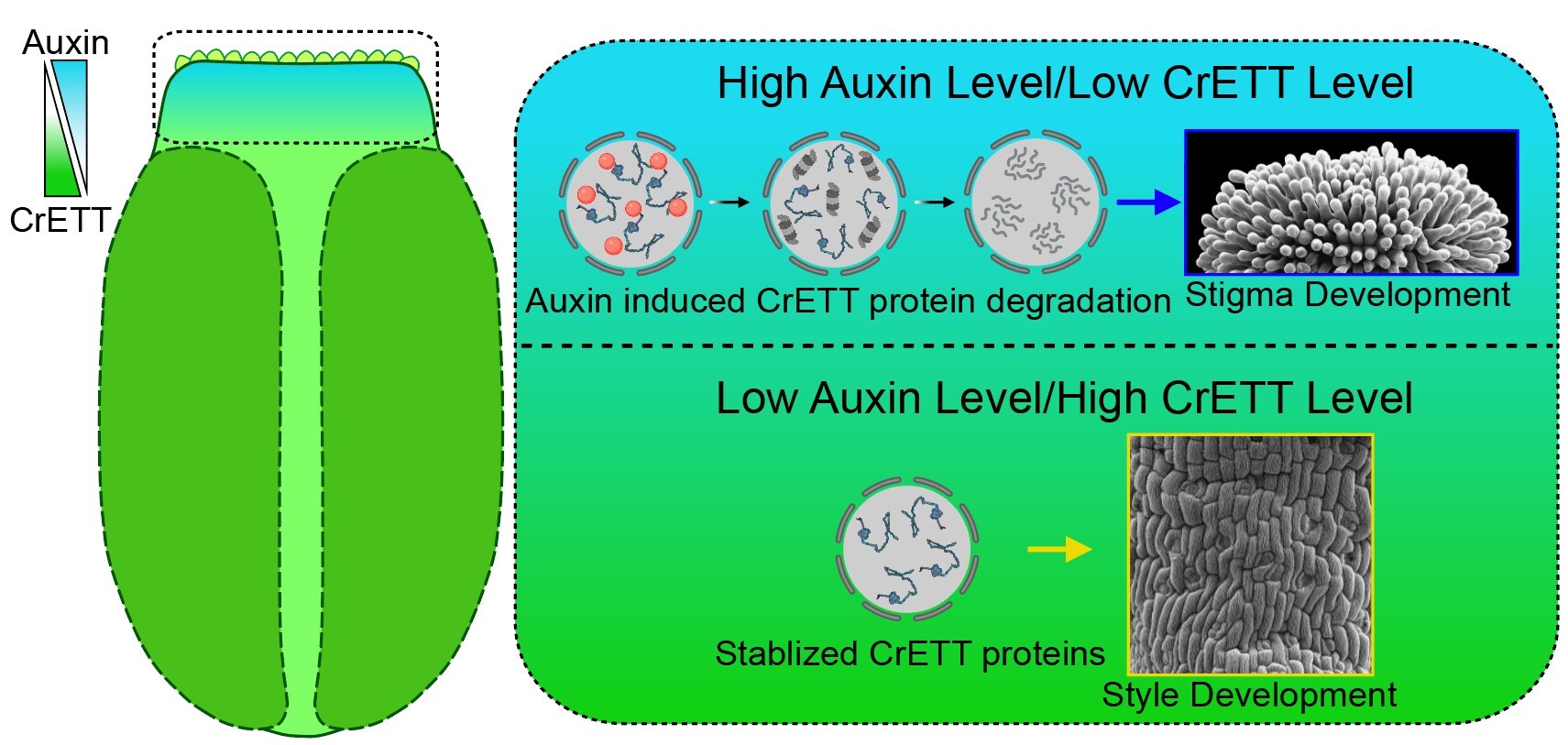
Schematic model for auxin-dependent CrETT degradation in stigma-style boundary establishment. (Image by DONG Yang)
<関連情報>
- https://english.cas.cn/newsroom/research-news/202608/t20260824_1188748.shtml
- https://www.pnas.org/doi/10.1073/pnas.2612105123
オーキシン誘導性ARF転写因子の分解が組織境界を規定する Auxin-induced ARF transcription factor degradation defines tissue boundaries
Jeonghwan Ahn, Quan Yuan, Yi-Ning Ding, +21 , and Yang Dong
Proceedings of the National Academy of Sciences Published:August 25, 2026
DOI:https://doi.org/10.1073/pnas.2612105123
Abstract
How organs partition themselves into discrete domains with distinct functions is a fundamental question in biology. The gynoecium of flowering plants provides an excellent system to address this question. Here, we show that the boundary between the stigma and style at the gynoecium apex is established by the complementary distribution of the phytohormone auxin and the Auxin Response Factor (ARF), ETTIN (ETT). Mechanistically, auxin induces ETT protein destabilization via the ubiquitin–proteasome pathway. A short sequence motif within an intrinsically disordered region is required for this auxin-triggered degradation. Disruption of this motif leads to ectopic ETT accumulation at the gynoecium apex and consequently abolishes stigma-style boundary development. We further demonstrate that this previously unrecognized mode of auxin-induced ARF instability is evolutionarily conserved among ETT orthologs across angiosperms. In summary, this study reveals how graded auxin distribution affects ARF transcription factor activity, contributing to the establishment of the stigma-style boundary, ensuring correct gynoecium formation and reproductive success in flowering plants.