2026-09-02 東北大学
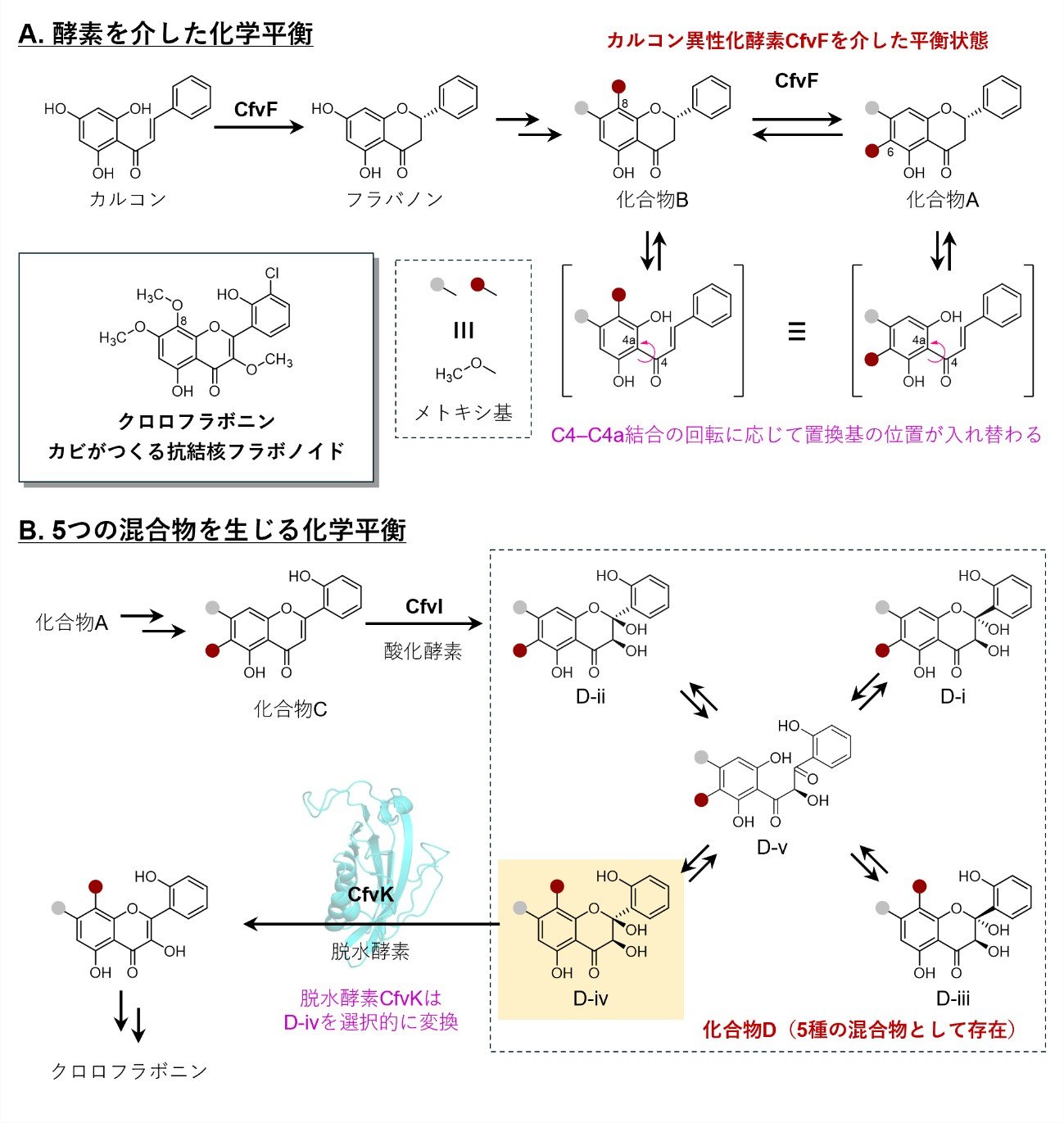
図. クロロフラボニンの生合成を特徴づける2つの平衡状態
<関連情報>
- https://www.tohoku.ac.jp/japanese/2026/09/press20260902-01-chlorflavonin.html
- https://pubs.acs.org/jacsat/article/doi/10.1021/jacs.6c13856/5361405/The-Biosynthesis-of-a-Fungal-Flavonoid
真菌フラボノイドであるクロルフラボニンの生合成は、2種類の平衡状態によって精密に制御される The Biosynthesis of a Fungal Flavonoid, Chlorflavonin, Precisely Controlled by Two Types of Equilibrium States
Sho Furumura;Taro Ozaki;Kazuya Hasegawa;Hironori Hayashi;Masao Inoue;Kaori Fujimoto;Yohei Morishita;Mitsunori Ikeguchi;Takashi Kumasaka;Eiichi N. Kodama;Tohru Taniguchi;Teigo Asai
Journal of the American Chemical Society Published:August 29, 2026
DOI:https://doi.org/10.1021/jacs.6c13856
Abstract
Flavonoids are polyphenolic natural products predominantly isolated from plants and exhibit a diverse array of biological activities. Because they serve as important pharmaceuticals and nutraceuticals, there is a strong demand for their sustainable supply. Chlorflavonin is a rare fungal flavonoid with potent antitubercular activity. While its biosynthetic enzymes are expected to be valuable tools for application in fungal production of flavonoids, the biosynthetic pathway remains unknown. Here, we elucidate the complete biosynthetic pathway for chlorflavonin through detailed functional analysis of each biosynthetic enzyme. Previously, stepwise and straightforward introduction of 3-, 7-, and 8-methoxy; 2′-hydroxy; and 3′-chloro functionalities have been proposed. In contrast to this proposal, we uncovered an intricate biosynthetic route involving a dynamic interconversion between the 6- and 8-methoxy forms of flavonoid skeletons mediated by the chalcone isomerase CfvF and the flavin-dependent oxygenase CfvI. CfvF interconverted the 6- and 8-methoxyflavanones, likely via a chalcone intermediate. CfvI oxidized the chemically inert 2,3-double bond of flavanone, giving the hemiacetal product. Although these enzymes generate products existing in equilibrium states, respective downstream enzymes catalyze selective conversion of one specific species, facilitating smooth progression to the final product. We also solved the crystal structure of CfvK, the dehydratase that selectively converts the 8-methoxy form of the CfvI product. Through analyzing the structure complexed with its substrate and product and site-directed mutagenesis, key residues determining the substrate selectivity were identified. Our comprehensive analysis established a rational framework for preparing 46 flavonoids, including unnatural ones, setting the stage for fungal production of structurally diverse flavonoids.