
2026-9-29 京都大学
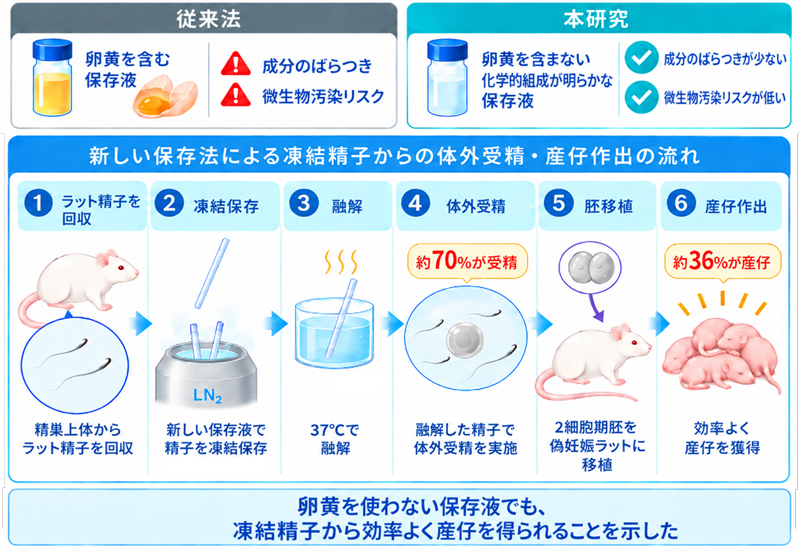
作成者:守田昂太郎(イラストの生成にOpenAI ChatGPT Images 2.5を使用)
<関連情報>
- https://www.kyoto-u.ac.jp/ja/research-news/2026-09-29
- https://academic.oup.com/biolreprod/advance-article/doi/10.1093/biolre/ioag200/8802127
ラット精⼦⽤の化学的組成が明らかな凍結保存液の開発と体外受精法による産仔の産⽣ Development of a chemically defined cryopreservation solution for rat sperm and production of offspring by in vitro fertilization
Kohtaro Morita, Keiji Mochida, Ayumi Hasegawa, Shunya Ihashi, Kento Morita, Saki Wajima, Miho Kohara, Tadashi Sankai, Arata Honda, Kimiko Inoue,…
Biology of Reproduction Published:16 September 2026
DOI:https://doi.org/10.1093/biolre/ioag200
Abstract
In vitro fertilization (IVF) and artificial insemination (AI) using frozen-thawed rat sperm have been established to enable the production of viable offspring. However, the current standard cryopreservation solution, which contains chicken egg yolk and Orvus ES Paste (OEP; sodium lauryl sulfate and other undefined components), poses the risk of microbial contamination and limits the experimental reproducibility of IVF and AI. In this study, we developed a chemically defined cryopreservation solution that does not contain chicken egg yolk or OEP and evaluated its efficacy in IVF. After examining the effects of various cryoprotective agents on sperm motility, we found that OptiPrep (a chemically defined reagent) and ethylene glycol in a lactose solution best preserved sperm motility after freezing and thawing. In addition, sericin, a cell membrane protective agent, effectively reduced damage to the plasma and acrosomal membranes of the sperm head. Although the fertilization rate of the sperm cryopreserved in a chemically defined solution (71.4%) was significantly lower than that of fresh sperm (90.5%), fertilized oocytes were successfully obtained. Approximately 60% of the fertilized oocytes developed to the blastocyst stage in vitro. Furthermore, when two-cell embryos were transferred to the oviducts of pseudopregnant females, 36% developed into offspring. Taken together, our results suggest a new strategy for the cryopreservation of rat strains using a chemically defined sperm-freezing solution, enabling the safe and reproducible production of offspring.
