2026-10-29 京都大学,科学技術振興機構
京都大学と科学技術振興機構(JST)などの研究グループは、異なる動物種の遺伝子発現データを比較し、種を超えて似た役割を担う遺伝子の対応候補を推定する解析手法「Species-OT」を開発した。動物実験で得られた知見をヒトの生物学的理解に応用するには、種間で遺伝子の働きがどのように対応するかを把握する必要があるが、DNA配列の類似性だけでは機能の対応を十分に判断できない。そこで本手法は、多数の遺伝子の発現パターンが形成する全体的な「形」を幾何学的に比較し、種間の対応候補とデータ全体の違いを定量化する。マウス、カニクイザル、ヒトの細胞分化過程や、6種の哺乳類の多能性幹細胞のデータに適用し、既知の生物学的知見と整合する遺伝子対応を上位候補として抽出できた。種に共通する仕組みと種固有の特徴の解明を支援し、動物実験の結果をヒトへ応用する研究の高度化が期待される。
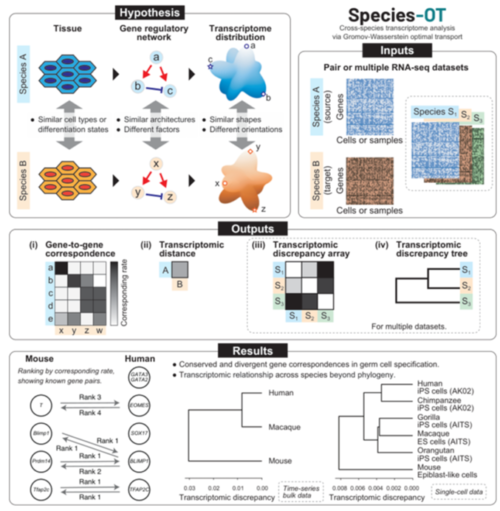
図1. Species-OT の概要と、マウス・カニクイザル・ヒトの始原生殖細胞誘導系から取得したバルクRNAseq データや、哺乳類6種の多能性幹細胞から取得したシングルセルRNA-seqデータにSpecies-OTを適用した結果のまとめ。原著グラフィカルアブストラクトより。
<関連情報>
異種間トランスクリプトーム対応の幾何学的推論
Geometric inference of cross-species transcriptome correspondence
Yuya Tokuta ∙ Tomonori Nakamura ∙ Kohei Fujiwara ∙ … ∙ Mitinori Saitou ∙ Yusuke Imoto ∙ Yasuaki Hiraoka
Cell Reports Methods Published:October 28, 2026
DOI:https://doi.org/10.1016/j.crmeth.2026.101643
Highlights
•Species-OT geometrically compares species’ transcriptomes using optimal transport
•Species-OT infers gene correspondences from the perspective of regulatory roles
•Species-OT quantifies inter-species differences in cell fate specification
•Transcriptomic divergence in pluripotent stem cells of mammals is displayed
Summary
Sequence homology reveals evolutionary gene correspondences, but identifying functionally corresponding genes within specific cell types or during cell fate specification remains non-trivial. Here, frameworks that translate insights from model organisms into other species would accelerate wet-lab studies, so we develop Species-OT, a cross-species transcriptome analysis framework using Gromov-Wasserstein optimal transport, which quantitatively compares the geometry of transcriptome distributions. Given a pair of bulk or single-cell RNA sequencing (RNA-seq) datasets, Species-OT returns a gene-to-gene correspondence capturing probabilistic alignments of regulatory roles and a transcriptomic distance quantifying overall divergence. Applied pairwise, Species-OT yields a transcriptomic discrepancy array and a hierarchical clustering tree analogous to a phylogenetic tree. We validate Species-OT using bulk RNA-seq data for cell fate specification from pluripotent stem cells in mice, monkeys, and humans and single-cell RNA-seq (scRNA-seq) data from pluripotent stem cells of six mammalian species. Species-OT identifies gene correspondences within cell fate specification, while transcriptomic discrepancies recapitulate expected species relationships.