2026-10-28 がん研究会がん研究所
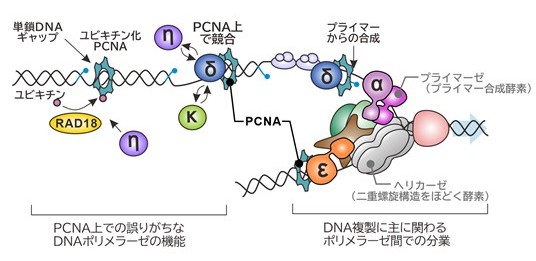
図1 誤りがちなDNAポリメラーゼPolηがDNA複製に関与するメカニズム
<関連情報>
- https://www.jfcr.or.jp/laboratory/news/12303.html
- https://www.nature.com/articles/s41467-026-78467-z
ヒトDNA複製におけるDNAポリメラーゼηの鎖および複製タイミング依存的な機能 Strand- and replication timing-dependent functions of DNA polymerase η in human DNA replication
Lewis J. Bainbridge, Yuji Masuda, Tamiko Minamisawa, Mami Takahashi, Kanae Kaneko, Chikahide Masutani & Yasukazu Daigaku
Nature Communications Published:28 October 2026
DOI:https://doi.org/10.1038/s41467-026-78467-z
Abstract
Efficient DNA replication requires coordinated use of replicative and error-prone polymerases, which provide flexibility at the cost of mutagenesis. DNA polymerase η (Pol η) tolerates UV-induced lesions via translesion synthesis (TLS), but may contribute more broadly to DNA synthesis. Using polymerase usage sequencing (Pu-seq), we map Pol η activity genome-wide during unperturbed replication in human cells. Pol η preferentially participates in lagging strand replication, as in budding yeast. This bias requires direct PCNA interaction, suggesting stochastic engagement of PCNA-bound intermediates at replication forks. Pol η usage also varies across S phase, with PCNA ubiquitylation-dependent enrichment in late-replicating domains. In cancer genomes, characteristic Pol η mutations are enriched in late-replicating regions and correlate with RAD18 expression, linking PCNA ubiquitylation to Pol η-mediated mutagenesis. Thus, Pol η usage is biased by strand and replication timing during unperturbed replication and may contribute to mutational burden in human genomes.