2026-10-29 筑波大学
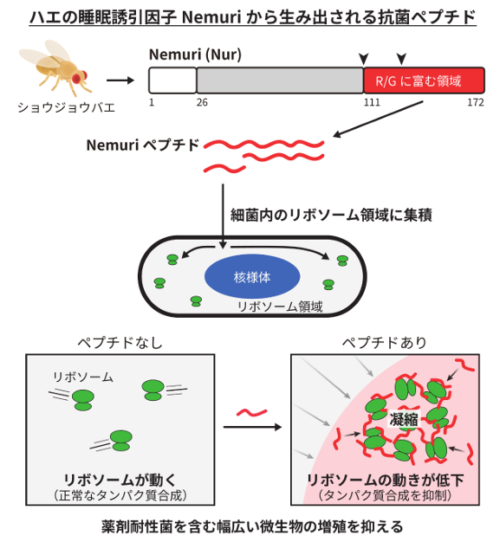
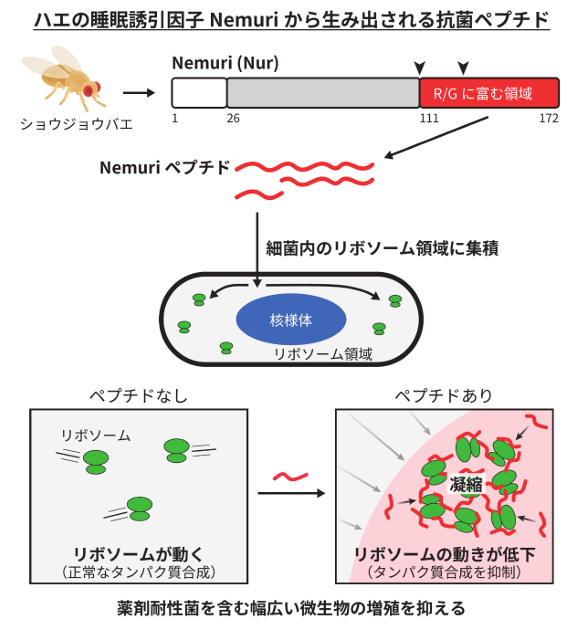
図 Nemuri由来ペプチドで観察された分⼦メカニズムの概要 Nemuri 由来のアルギニン/グリシンに富む短鎖ペプチドは、顕著な細菌膜損傷を起こさず細菌内へ移⾏し、RNA やリボソーム表⾯の複数の箇所に結合する。これに伴い、リボソームの動的活性が失われ凝集し、タンパク質合成と細菌の増殖が抑えられる。
<関連情報>
- https://www.tsukuba.ac.jp/journal/medicine-health/20261029190000.html
- https://www.tsukuba.ac.jp/journal/pdf/p20261029190000.pdf
- https://www.nature.com/articles/s41467-026-78960-5
リボソーム凝縮を誘導して翻訳を阻害するNemuri由来抗菌ペプチド Antimicrobial peptides derived from Nemuri induce ribosomal condensation to inhibit translation
Suguru Nishinami, Moynul Hasan, Tatsuya Niwa, Tomohiro Inui, Takeshi Yokoyama, Hiroto Otsuki, Yuta Ogasawara, Hiroka Sugai, Yuta Otobe, Masato Machida, Mohammed Abdelaziz, Natsumi Ageta-Ishihara, Ryohei Sasaki, Yoshimasa Ishizaki, Kenji Iwasaki, Yuko Fujioka, Tomokazu Ohishi, Shinji Kajimoto, Takakazu Nakabayashi, Yoshikazu Tanaka, Hikari Yoshitane, Hiroyuki Kumeta, Amita Sehgal, Masayuki Igarashi, …
Nature Communications Published:29 October 2026
DOI:https://doi.org/10.1038/s41467-026-78960-5
Abstract
Antibiotic resistance is a global health threat requiring antimicrobials with alternative modes of action. Growing evidence indicates that bacteria organize key intracellular processes through biomolecular condensates and other forms of spatial organization, yet whether such spatial organization can be exploited as an antimicrobial target remains unclear. Here, we identify intrinsically disordered antimicrobial peptides, generated from the Drosophila sleep-inducing protein Nemuri, that inhibit bacterial growth by targeting ribosomal organization. Mechanistically, these peptides enter bacterial cells without overt membrane disruption and accumulate in ribosome-rich regions, where they bind broadly to RNA and ribosomal surfaces through multivalent interactions. This engagement remodels ribosome-rich regions into condensates with reduced ribosomal mobility, thereby suppressing global protein synthesis and distinguishing these peptides from canonical site-specific ribosome-targeting antibiotics. Furthermore, Nemuri-derived peptides exhibit broad-spectrum antimicrobial activity, including activity against drug-resistant pathogens, with low cytotoxicity toward Drosophila and mammalian cells. Together, our findings identify the organization and material dynamics of bacterial ribosomes as a biophysical vulnerability that can be exploited by antimicrobial peptides, revealing how a naturally evolved metazoan host-defense system turns intracellular organization itself into an antibacterial target.