2026-11-03 九州大学
九州大学の研究グループは、脳が複数の記憶の中から特定の記憶を選択的に忘却させる分子と神経回路、その働くタイミングを明らかにした。研究では、神経系の構造が詳細に解明されている線虫(C. elegans)をモデルとして、餌と匂いの学習に伴う忘却の仕組みを解析した。その結果、記憶を保持する神経細胞に対して、別の神経細胞から忘却を促進するシグナルが送られ、そのシグナルを担う分子と神経回路が特定された。さらに、この回路は学習後の特定の時期に働き、2種類の匂いを同時に学習した場合でも、一方の記憶だけを選択的に忘れさせることが判明した。シグナルを受け取る受容体にはヒトにも類似分子が存在し、記憶に関わる脳領域で働くことが知られている。本成果は、記憶の選択的な保持と忘却を制御する神経メカニズムの理解を進め、将来的には忘却の異常が関係する疾患の研究につながる可能性がある。
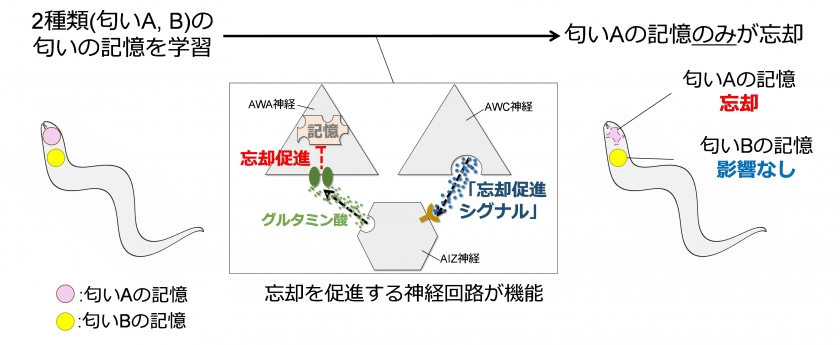
2種類 (匂いA, B)の匂いを同時に学習しても、忘却を促進する神経回路によって、一方の記憶のみが忘却される。
<関連情報>
神経ペプチド-グルタミン酸回路は嗅覚学習の選択的忘却を制御する
Neuropeptidergic-glutamatergic circuit regulates selective forgetting of olfactory learning
Yuuki Onishi ∙ Mary Arai ∙ Noriko Sato ∙ … ∙ Jamine Hooi-Min Teo ∙ Tomohiro Kitazono ∙ Takeshi Ishihara
Current Biology Published:November 2, 2026
DOI:https://doi.org/10.1016/j.cub.2026.10.015
Highlights
•AWC-derived neuropeptide NLP-47 acts on GNRR-1 in AIZ to promote forgetting
•Glutamate from AIZ erases the memory trace in AWA via the AMPA-type receptor GLR-4
•Optogenetic silencing defines a time window for forgetting after conditioning
•The circuit erases a memory without affecting another formed simultaneously
Summary
Forgetting is an active and essential process for adapting to constantly changing environments, yet the molecular and circuit mechanisms underlying selective forgetting remain poorly understood. Our previous studies in the nematode Caenorhabditis elegans suggested that non-cell-autonomous neurosecretory signals accelerate forgetting of olfactory memory for diacetyl, an attractive odorant, by erasing its memory trace, which can be detected as changes in odor-evoked Ca2+ responses in sensory neurons. However, the identity of the forgetting signal, the circuit through which it acts to erase the sensory memory trace, and the time window in which forgetting occurs have remained elusive. Here, we identify a neuropeptidergic-glutamatergic circuit in C. elegans that drives the selective forgetting of olfactory memory. Our genetic and imaging analyses revealed that the gonadotropin-releasing hormone (GnRH)-related neuropeptide NLP-47, secreted from AWC neurons, acts on its receptor GNRR-1 in AIZ interneurons. Glutamatergic neurotransmission from AIZ interneurons then erases the sensory memory trace in AWA neurons via GLR-4, an AMPA-type receptor expressed in AWA. Optogenetic silencing of AWC and AIZ showed that this circuit acts during the recovery phase following conditioning, defining a critical temporal window for active forgetting. This neuropeptidergic-glutamatergic pathway selectively promotes forgetting of a specific odorant memory without affecting another formed simultaneously. Together, our findings demonstrate that neuropeptidergic signaling promotes selective forgetting via a glutamatergic circuit, highlighting that active forgetting is regulated within a critical temporal window and with remarkable specificity.