2026-11-06 カリフォルニア大学サンタクルーズ校(UCSC)
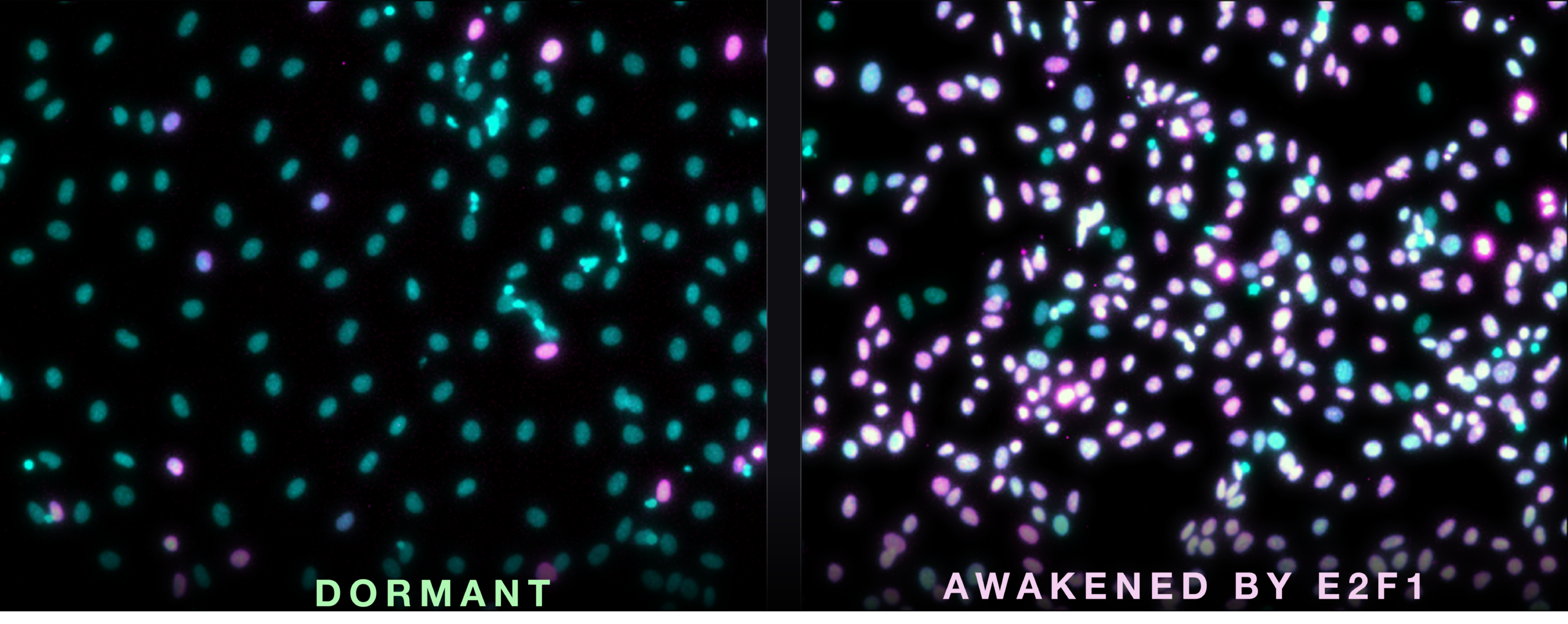
On the left, dormant cells (turquoise) lie in wait for biological signals. On the right, cells are awakened by E2F1 (magenta) and begin to divide.
<関連情報>
- https://news.ucsc.edu/2026/11/cancer-linked-gene-uses-shortcut-to-trigger-cell-division/
- https://link.springer.com/article/10.1038/s44318-026-00936-4
E2F1はクロマチンアクセシビリティを変化させることなくG0-G1再突入転写プログラムを誘導する E2F1 induces a G0-G1 reentry transcriptional program without changing chromatin accessibility
Gerrald A Lodewijk, Benjamin R Topacio, Seungho Lee, Sayaka Kozuki, Alexis Abigail A Alburo, Znala Williams, Clara J Han, Abolfazl Zargari, Tilini U Wijeratne, Neda Bidoki, Silvart Arabian, Edward Wu, Eric Malekos, Joscha Weiss, Gerd A Müller, Vanessa D Jonsson, Nicolas H Thomä, Seth M Rubin & S Ali Shariati
The EMBO Journal Published:06 November 2026
DOI:https://doi.org/10.1038/s44318-026-00936-4
Abstract
Quiescent cells repress cell-cycle genes via chromatin-based mechanisms to maintain a non-dividing state, yet remain poised to reenter the cell cycle upon stimulation. E2F1, a canonical activator of cell-cycle genes, is sufficient to induce cell-cycle reentry from quiescence, but how it overcomes chromatin-mediated repression remains unclear. Here, we show that inducible E2F1 expression triggers exit from quiescence without changes in chromatin accessibility by harnessing regulatory elements with limited accessibility. Time-resolved transcriptomic analysis demonstrates that E2F1 induces an accelerated transcriptional program compared to serum stimulation. Unlike serum, which triggers broad chromatin remodeling, E2F1 activates genes within a chromatin context with limited accessibility. ChIP-seq analyses reveal that E2F1 binds target sites in quiescent cells to activate canonical cell-cycle genes. Biochemical reconstitution demonstrates that E2F1 binds nucleosomes and accesses DNA wrapped by histones. These findings suggest that E2F1 accesses nucleosome-associated DNA and initiates transcription without major chromatin reorganization. Our work redefines the relationship between transcription factor and chromatin dynamics during fate transitions and establishes E2F1 as a potent regulator capable of inducing cell-cycle reentry without changing chromatin accessibility.