2026-11-09 東京科学大学
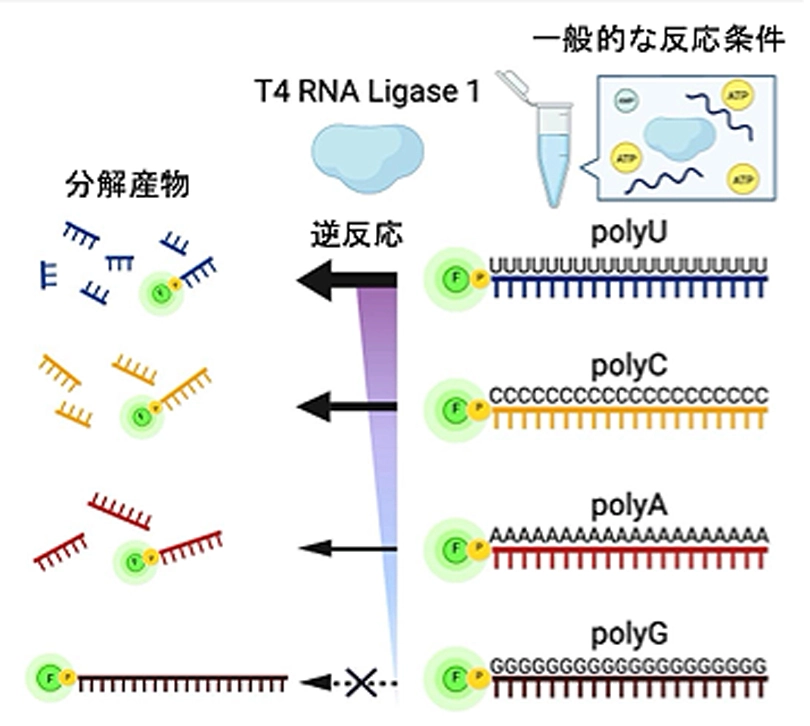
図1. T4 RNAリガーゼ1(Rnl1)の逆反応によるRNA分解の模式図
標準的な連結反応条件下では、polyU、polyC、polyAの順に分解されやすく(矢印の太さ)、polyGでは分解が見られない。(Credit: Adachi et al. 2026 ChemBioChemのGraphical abstractから改変)
背景
<関連情報>
- https://www.isct.ac.jp/ja/news/72rcrgsokshz
- https://chemistry-europe.onlinelibrary.wiley.com/doi/10.1002/cbic.70559
T4 RNAリガーゼ1によるRNA連結と分解の二重性:AMP駆動型、核酸塩基依存性逆反応に関する考察 The Dual Nature of RNA Ligation and Degradation by T4 RNA Ligase 1: Insights Into an AMP-Driven, Nucleobase-Dependent Reverse Reaction
Nozomi Adachi, Wataru Takahagi, Shohei Terazawa, Ryoji F. Abe, Nao Masuda, Kosuke Fujishima
ChemBioChem Published: 28 October 2026
DOI:https://doi.org/10.1002/cbic.70559
Abstract
T4 RNA Ligase 1 (Rnl1) catalyzes the ligation of a 5′-phosphate to a 3′-hydroxyl in single-stranded RNA and is widely used in RNA biotechnology for applications such as RNA library preparation and 3′-adapter ligation. In addition to ligation reaction, Rnl1 catalyzes the reverse reaction, leading to RNA degradation. However, how RNA sequence affects susceptibility to this reverse reaction remains unclear, and practical strategies for controlling it through buffer conditions have not been established. Previous studies showed that AMP promotes and ATP suppresses the reverse reaction; we confirmed these effects by electrophoretic analysis of FAM-labeled RNA homopolymers, a substrate not previously examined. Furthermore, using miRNA substrates, we demonstrated that the reverse reaction can occur under conditions that more closely resemble the practical conditions in which Rnl1 is used, thereby extending the relevance of previous findings. Additionally, we showed that the Rnl1-mediated reverse reaction exhibits pronounced nucleobase preference. The reverse reaction is suppressed by elevated temperature and duplex formation. Furthermore, experimental results combined with stochastic simulations indicate that Rnl1-mediated degradation proceeds via an endonucleolytic mechanism. These findings define how reaction conditions and nucleobase difference influence reverse reaction efficiency and provide practical guidance for minimizing RNA degradation while maintaining ligation efficiency.