2026-11-16 ローレンスバークレー国立研究所(LBNL)
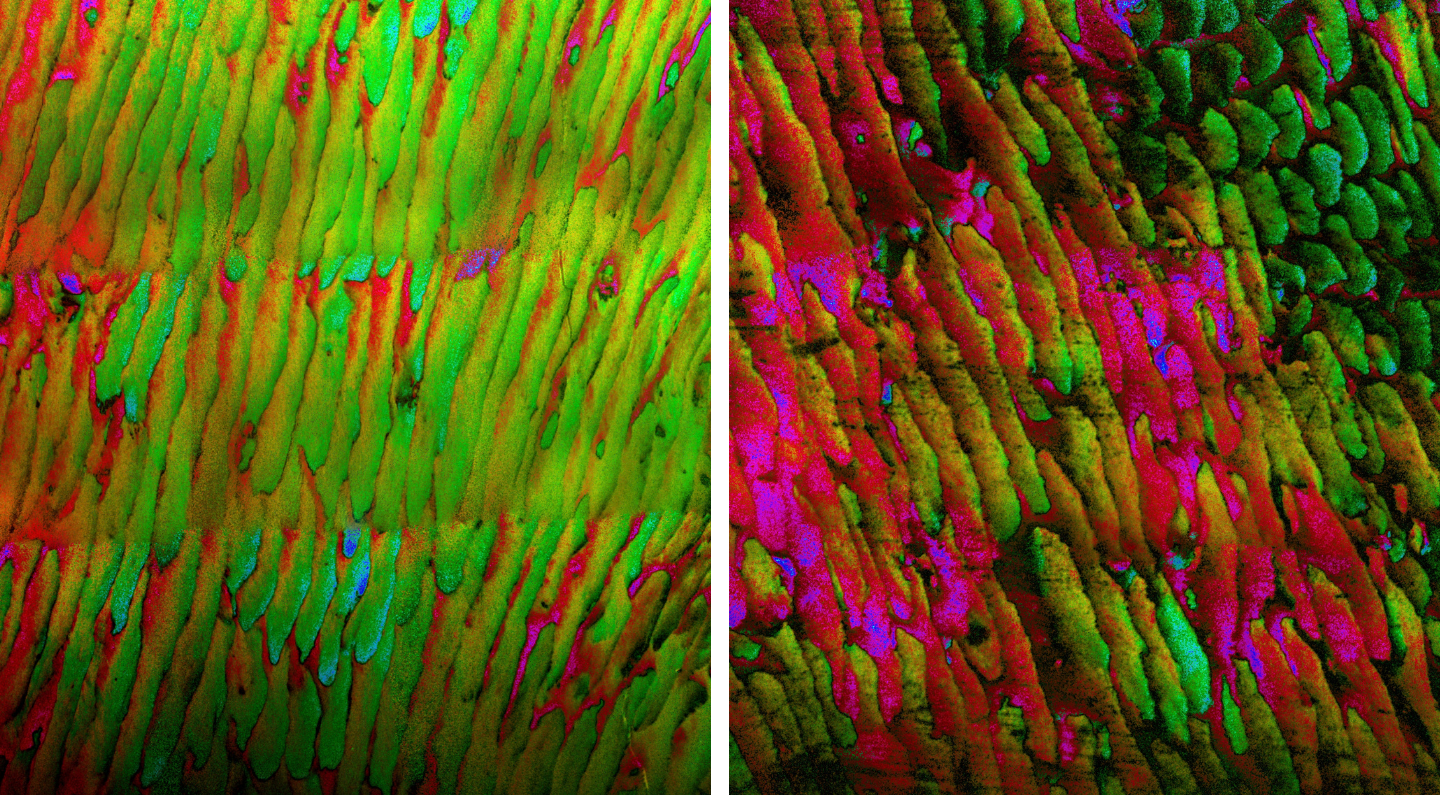
X-ray photoemission electron microscopy (XPEEM) images comparing nanocrystals in human tooth enamel before (left) and after (right) the advent of agriculture, revealing shifts in nanocrystal alignment. Color indicates each nanocrystal’s angle relative to the incoming X-ray beam; nanocrystals sharing a color share the same orientation. Left: Tooth enamel from a hunter-gatherer in Spain, roughly 40,000 years ago, prior to agriculture. Right: Tooth enamel from an agricultural population in the UK, roughly 1,550 years ago.
<関連情報>
- https://newscenter.lbl.gov/2026/11/16/nanocrystal-structure-made-human-teeth-tougher-after-historic-dietary-shifts/
- https://www.nature.com/articles/s41586-026-10583-8
肉食と農耕の進展に伴い増加した歯エナメル質ナノ結晶の結晶方位のずれ
(Enamel nanocrystal misorientation increased with meat-eating and agriculture)
Pupa U. P. A. Gilbert, Daniel R. Green, Patrick Mahoney, Debbie Guatelli-Steinberg, W. Scott McGraw, Emma Lagan, Fredrick Kyalo Manthi, Samuel Muteti, Emmanuel Ndiema, Fernando Ramirez Rozzi, Cayla A. Stifler, Connor A. Schmidt, Barat Q. Achinuq, Andreas Scholl, Benjamin Gilbert, Mackie C. O’Hara
Nature, Volume 654, Issue 8117, pp. 76–84 (2026):2026-06-03
DOI:10.1038/s41586-026-10583-8
歯のエナメル質は、ヒドロキシアパタイトのナノ結晶が束状に配列した多階層構造を持ち、亀裂の進展を抑えることで歯の強度を支えている。本研究では、霊長類9種の現生・化石標本を含む12個の歯を対象に、ナノ結晶の結晶方位のずれ(misorientation)をPELICAN法で測定し、食性との関係を調べた。その結果、ヒト以外の類人猿やサルでは、硬い食物を摂取する種ほど隣接するナノ結晶間の方位のずれが大きかった。さらに人類系統では、過去160万年間に方位のずれが増加し、約200万~150万年前の肉食の拡大や、約1万2000年前に始まった農耕・石臼による穀物加工に対応して顕著な変化が認められた。一方、約250年前の産業革命に伴う食生活の変化では、同様の増加は確認されなかった。これらの結果は、歯の適応が形状や厚さなどの巨視的な変化だけでなく、ナノ結晶の結晶学的配列にも及ぶことを示している。ナノ結晶の方位のずれはエナメル質の亀裂抵抗性に寄与する可能性があり、耐久性を高める生体模倣材料の設計にも応用が期待される。
Tooth enamel has a hierarchical structure composed of hydroxyapatite nanocrystals arranged in bundles, which helps resist crack propagation and provides mechanical strength. This study investigated the relationship between diet and crystallographic misorientation between adjacent enamel nanocrystals. Using the PELICAN method, the researchers analysed 12 primate teeth representing nine species, including extant and fossil specimens. In non-human apes and monkeys, nanocrystal misorientation increased with the hardness of consumed foods. In the human lineage, misorientation also increased over the past 1.6 million years, with particularly notable changes associated with the expansion of meat consumption approximately 2.0–1.5 million years ago and the introduction of agriculture and stone-ground grains around 12,000 years ago. In contrast, no comparable increase was detected in association with the Industrial Revolution approximately 250 years ago. These findings indicate that dietary adaptation in teeth involves not only macroscopic changes in shape and thickness but also nanoscale crystallographic organization. Nanocrystal misorientation may contribute to enamel’s resistance to fracture, suggesting potential applications in the design of durable bioinspired materials.
原論文:Nature