
2026-06-01 中国科学院(CAS)
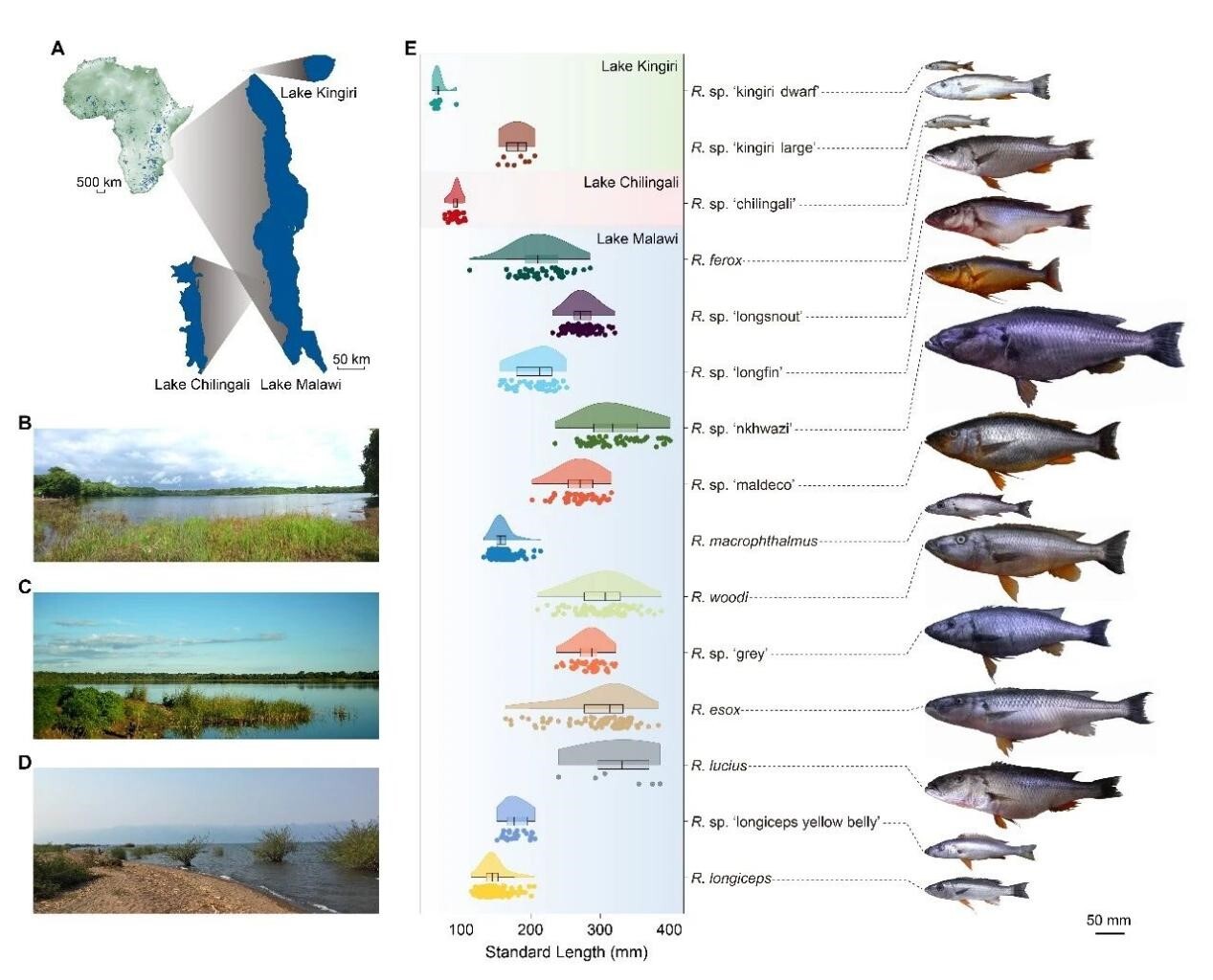
Sampling sites and body size variation in Rhamphochromis cichlid fish species (Image by IHB)
<関連情報>
- https://english.cas.cn/newsroom/research-news/202606/t20260601_1160253.shtml
- https://genome.cshlp.org/content/36/5/949
マラウイ湖における捕食性シクリッド魚類の種分化過程における動的な体サイズ進化 Dynamic body size evolution during speciation of predatory cichlid fishes in the Lake Malawi superradiation
Liandong Yang,Holly Scott,Benjamin P. Ngatunga,Asilatu H. Shechonge ,George F. Turner,Martin J. Genner
Genome Research Published: May 4, 2026
DOI:https://doi.org/10.1101/gr.281193.125
Abstract
Evolutionary divergence in body size is common in animal adaptive radiations and is often associated with differences in key ecological traits, including habitat use and prey consumption. Here we characterize a notable case of body size–associated adaptive radiation in a group of predatory open water cichlid fish species from the Lake Malawi catchment. Using whole-genome sequences, we show that body size differences have evolved multiple times in the focal genus, Rhamphochromis, and that the group possesses well-defined signals of ancient interspecific hybridization. We identify genetic variants strongly associated with body size and show that these variants are connected to genes enriched for functions in vertebrate skeletal and nervous system development. We focus our analyses on two species of Rhamphochromis endemic to Lake Kingiri, a small (600 m diameter) crater lake geographically isolated from the main body of Lake Malawi but within the catchment. We show that these two ecomorphologically divergent sympatric species—one small-bodied, the other larger-bodied—share a unique common ancestor and diverged from one another ∼2000 years ago. We demonstrate strong directional selection focused on the larger-bodied Kingiri species, specifically on genetic variants connected to genes with anatomical development and nervous system function. Collectively, these results are supportive of body size–associated speciation taking place rapidly in the Lake Malawi cichlid fish superradiation. We conclude that body size–associated genetic variants have been important targets of selection during large-scale cichlid fish diversification, including in a crater lake sympatric speciation context.

