2026-09-09 国立循環器病研究センター,大阪大学
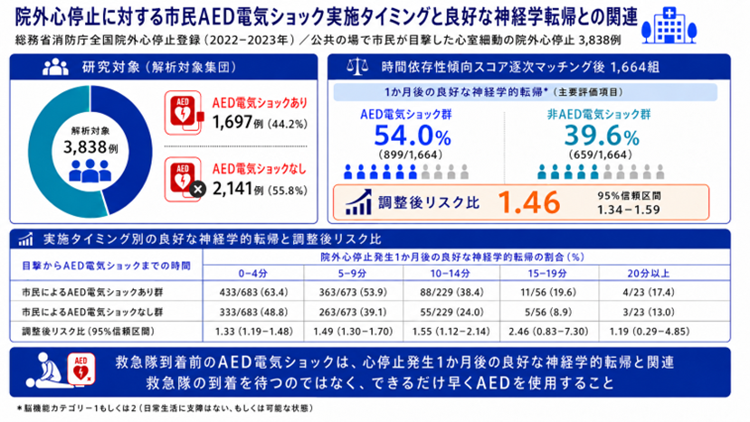
図1.研究概要図(Chat GPTにて作成)
<関連情報>
院外心停止患者に対する公共アクセス除細動のタイミング:時間依存傾向スコア逐次マッチング法を用いた全国コホート研究 Timing of Public‐Access Defibrillation for Patients With Out‐of‐Hospital Cardiac Arrest: A Nationwide Cohort Study Using Time‐Dependent Propensity Score Sequential Matching Approach
Haruka Shida, MPH, Yoshimitsu Shimomura, MD, PhD, Atsushi Hirayama, MD, MPH, Ryo Kawasaki, MD, PhD, Sho Komukai, PhD, Aiko Tanaka, MD, PhD, Tadaharu Shiozumi, MD, Tasuku Matsuyama, MD, PhD, Aya Fukuzawa, PhD, Kosuke Kiyohara, DrPH, and Tetsuhisa Kitamura, MD, DrPH
Journal of the American Heart Association Published: 31 July 2026
DOI:https://doi.org/10.1161/JAHA.126.051586
Abstract
Background
Earlier defibrillation is a key factor in improving survival in patients with out‐of‐hospital cardiac arrest due to ventricular fibrillation. Although the benefit of public‐access defibrillation (PAD) has been reported, its effectiveness has rarely been evaluated considering intervention time. We assessed whether the effect of PAD varies depending on the timing of defibrillation.
Methods
Using a nationwide, prospective, population‐based out‐of‐hospital cardiac arrest registry in Japan between 2022 and 2023, we included consecutive bystander‐witnessed ventricular fibrillation with resuscitation attempts in public locations. Patients with out‐of‐hospital cardiac arrest who received PAD before emergency medical services arrival were sequentially matched with patients at risk of receiving PAD on a minute‐by‐minute basis using time‐dependent propensity scores to address resuscitation time bias. The primary outcome was 1‐month survival with favorable neurological outcome, defined as a cerebral performance category scale of 1 or 2.
Results
After sequential matching, 1664 matched pairs were identified. The corrected risk ratio for 1‐month survival with favorable neurological outcome in the PAD group than in the non‐PAD group was 1.46 (95% CI, 1.34–1.59). The effect sizes by PAD timing were 1.33 (95% CI, 1.19–1.48) for 0 to 4 minutes, 1.49 (95% CI, 1.30–1.70) for 5 to 9 minutes, 1.55 (95% CI, 1.12–2.14) for 10 to 14 minutes, 2.46 (95% CI, 0.83–7.30) for 15 to 19 minutes, and 1.19 (95% CI, 0.29–4.85) after 20 minutes.
Conclusion
In Japan, among patients with bystander‐witnessed ventricular fibrillation in public locations, PAD before emergency medical services arrival was significantly associated with favorable neurological outcome, showing a directionally consistent association with improved outcomes regardless of time to emergency medical services arrival.