2026-02-24 リンショーピング大学
<関連情報>
- https://liu.se/en/news-item/precisare-dodstidpunkt-med-ai
- https://www.nature.com/articles/s41467-026-69158-w
人間のメタボロームと機械学習は死後経過時間の予測を改善する The human metabolome and machine learning improves predictions of the post-mortem interval
Rasmus Magnusson,Carl Söderberg,Liam J. Ward,Jenny Arpe,Fredrik C. Kugelberg,Albert Elmsjö,Henrik Green & Elin Nyman
Nature Communications Published:11 February 2026
DOI:https://doi.org/10.1038/s41467-026-69158-w
Abstract
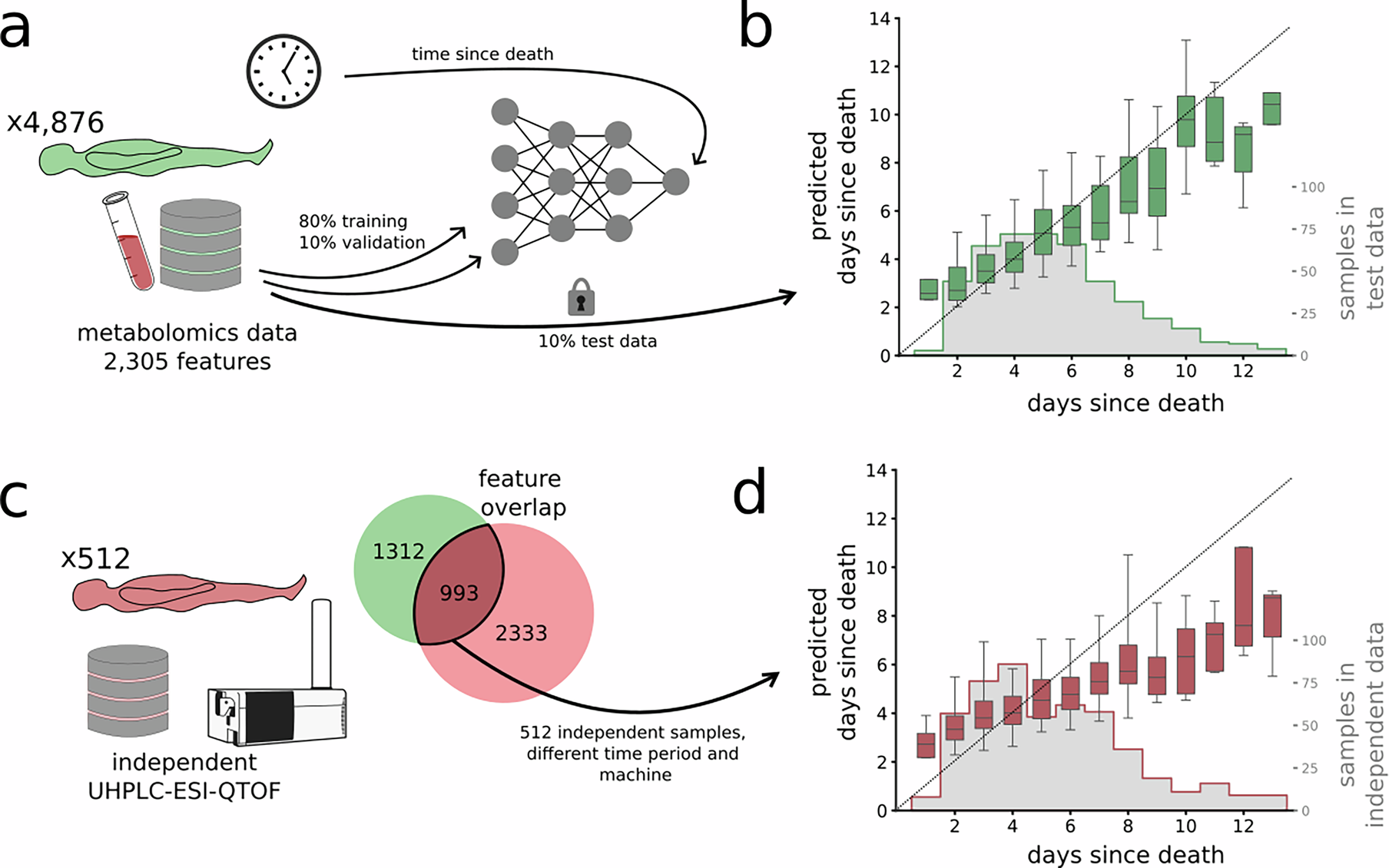
An accurate prediction of the time since death, known as the post-mortem interval, remains a critical research question in forensic and police investigations. Current methods, such as rectal temperature and vitreous potassium levels, only provide reliable post-mortem interval estimations up to 1–3 days. In this study, we use metabolomic data from routine toxicological screenings using femoral whole blood samples (n=4876 individuals) with known post-mortem interval of 1–67 days. We develop a neural network model that predicts the post-mortem interval with a mean/median absolute error of 1.45/1.03 days in unseen test cases, outperforming six other machine learning architectures. Pseudo-time series clustering of important model features reveals distinct metabolite dynamics, including markers of lipid degradation, mitochondrial dysfunction, and proteolysis. To assess generalizability, we apply the trained model to independent test data (n = 512 individuals) collected in a different year and analyzed on a separate mass spectrometry platform. Despite cross-platform variability, the model retains predictive performance (mean/median absolute error 1.78/1.29 days). We further show that robust models can be trained using only a few hundred cases, supporting scalability. Our findings demonstrate that post-mortem metabolomics, even when derived from routine toxicological workflows, can enable accurate post-mortem interval predictions and may offer a transferable framework for future forensic applications.