2026-03-05 ワシントン大学セントルイス校
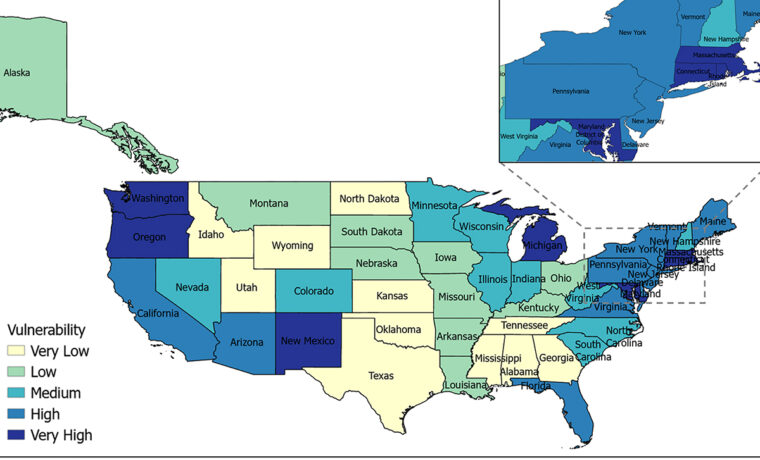
Researchers at WashU have put together a state-level influenza-like illness vulnerability map highlighting regions with varying levels of vulnerability to infectious disease outbreaks. Dark blues are areas more vulnerable because of complex socioeconomic, geographic and health factors including insurance rates, density of the population and poverty rates. (Image: Chakrabarty lab)
<関連情報>
- https://source.washu.edu/2026/03/index-provides-flu-risk-for-each-state/
- https://journals.plos.org/ploscompbiol/article?id=10.1371/journal.pcbi.1013839
米国人口におけるインフルエンザ様感染症に対する社会経済的脆弱性の空間的変動 Spatial variation in socio-economic vulnerability to Influenza-like Infection for the US population
Shrabani S. Tripathy,Joseph V. Puthussery,Taveen S. Kapoor,John R. Cirrito,Rajan K. Chakrabarty
PLOS Computational Biology Published: January 28, 2026
DOI:https://doi.org/10.1371/journal.pcbi.1013839
Abstract
This study aims to quantify environmental health impacts and assess risk by understanding the disproportionate burden of infectious diseases, specifically Influenza-like Illness (ILI), across regions with varying socio-economic characteristics. We introduce a novel vulnerability-based approach to better understand the complex relationship between socio-economic factors and ILI burden. We develop a machine-learning-driven framework to assess and map state-level socio-economic vulnerability to ILI in the United States. A vulnerability index was created by integrating 39 diverse socio-economic and health indicators from the latest CENSUS. A Random Forest Regression model then weighed these indicators to quantify each state’s vulnerability for the ILI values in 2022. To assess multicollinearity, Variance Inflation Factor (VIF) was calculated, and parameters were filtered to reduce the VIF. Key determinants of vulnerability include migration patterns, insurance coverage, and proportions of female and elderly populations. The resulting state-level vulnerability map reveals significant regional disparities. District of Columbia was identified as the most vulnerable state, followed by Massachusetts, Hawaii, New Mexico, and Rhode Island, all with normalized vulnerability indices exceeding 0.35. Our findings highlight significant regional variations in ILI vulnerability, emphasizing the need for targeted public health interventions tailored to state-specific socio-economic conditions. This scalable and adaptable methodology extends beyond influenza, offering a valuable approach for assessing vulnerability to a wide range of infectious diseases, strengthening epidemic preparedness and response.
Author summary
Socio-economic conditions significantly influence a location’s susceptibility to Influenza-like Illness (ILI). Identifying infection hotspots based on these factors and quantifying relative susceptibility is crucial for policymakers. A vulnerability index is an effective tool for this purpose. Our study employs a Random Forest-based technique to not only provide relative vulnerability values but also to identify the dominant socio-economic features contributing to high vulnerability in specific areas.