2026-03-26 中国科学院(CAS)

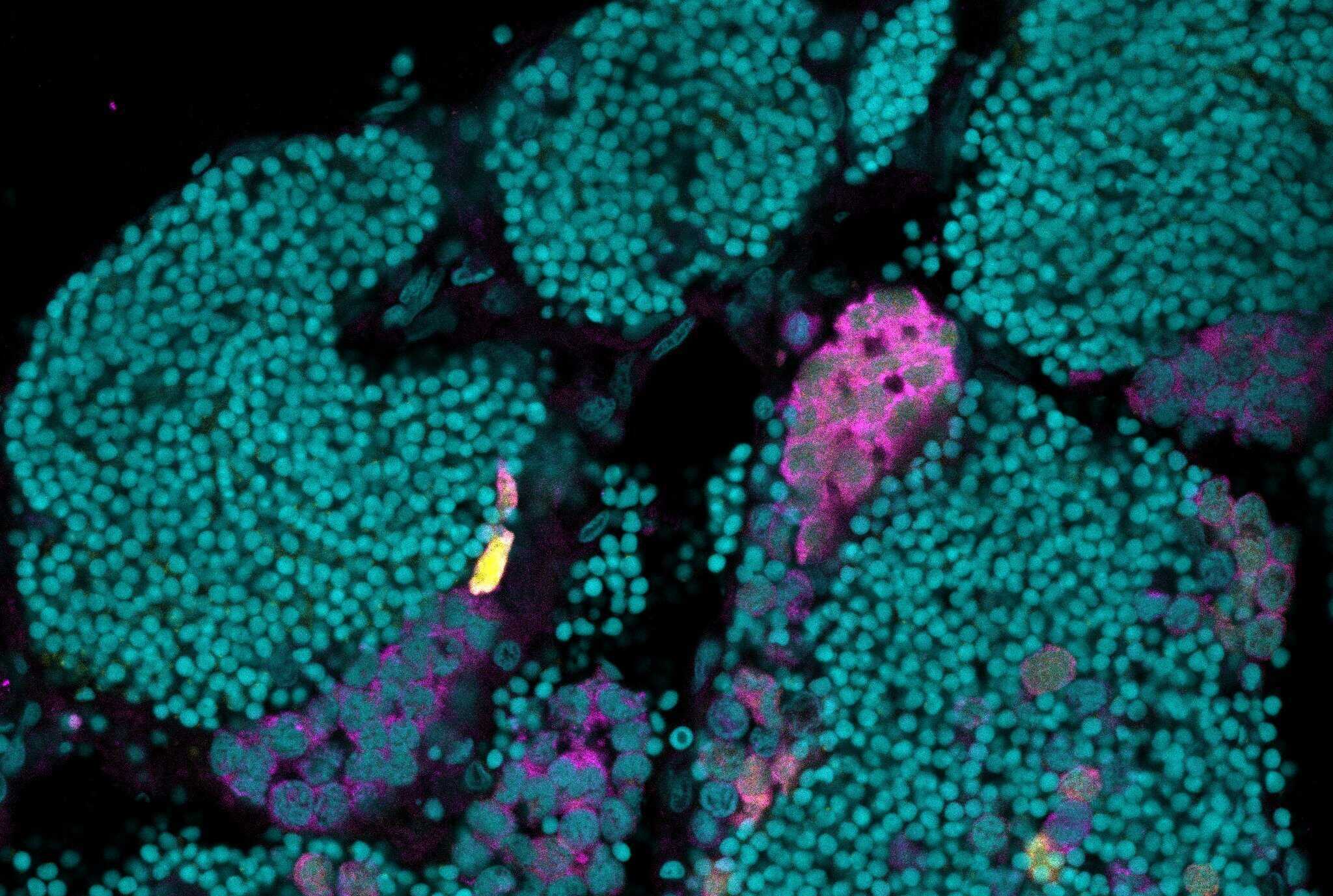
A synthetic gene circuit uses recombinase switches and feedback control to regulate population proportions. (Imade by Olga Aleksandrova)
<関連情報>
- https://english.cas.cn/newsroom/research-news/202603/t20260326_1153801.shtml
- https://www.nature.com/articles/s41586-026-10259-3
細胞比率制御のための合成回路 Synthetic circuits for cell ratio control
Bolin An,Tzu-Chieh Tang,Qian Zhang,Teng Wang,Yanyi Wang,Kesheng Gan,Kun Liu,Daniel L. Zhang,Yuzhu Liu,Yu Kui Pan,Min Yu,William M. Shaw,Qianyi Liang,Yaomin Wang,Christopher A. Vaiana,Chunbo Lou,Christopher A. Voigt,Timothy K. Lu,George M. Church & Chao Zhong
Nature Published:18 March 2026
DOI:https://doi.org/10.1038/s41586-026-10259-3
Abstract
Recent advances in genetic engineering have provided diverse tools for artificially diversifying both prokaryotic and eukaryotic cell populations1,2,3,4,5,6. However, achieving precise control over the ratios of multiple cell types within a population derived from a single founder remains a major challenge. Here we introduce a suite of recombinase-mediated genetic devices designed to accurately control population ratios, enabling the distribution of distinct functionalities across multiple cell types. We systematically evaluated key parameters that influence recombination efficiency and developed data-driven models to reliably predict binary differentiation outcomes. Using these devices, we constructed parallel and series circuit topologies to implement user-defined, multistep cell-fate branching programs. The branching devices facilitated the autonomous differentiation of precision fermentation consortia from a single founder yeast strain, optimizing cell-type ratios for applications such as pigmentation and cellulose degradation. Similar effects were obtained with mammalian cells. We also engineered multicellular aggregates with genetically encoded morphologies by coordinating self-organization through cell adhesion molecules. Our work provides a comprehensive characterization of recombinase-based cell-fate branching mechanisms and introduces an approach for constructing synthetic consortia and multicellular assemblies.