
2026-05-11 ロッキーズ国立研究所(NLR)
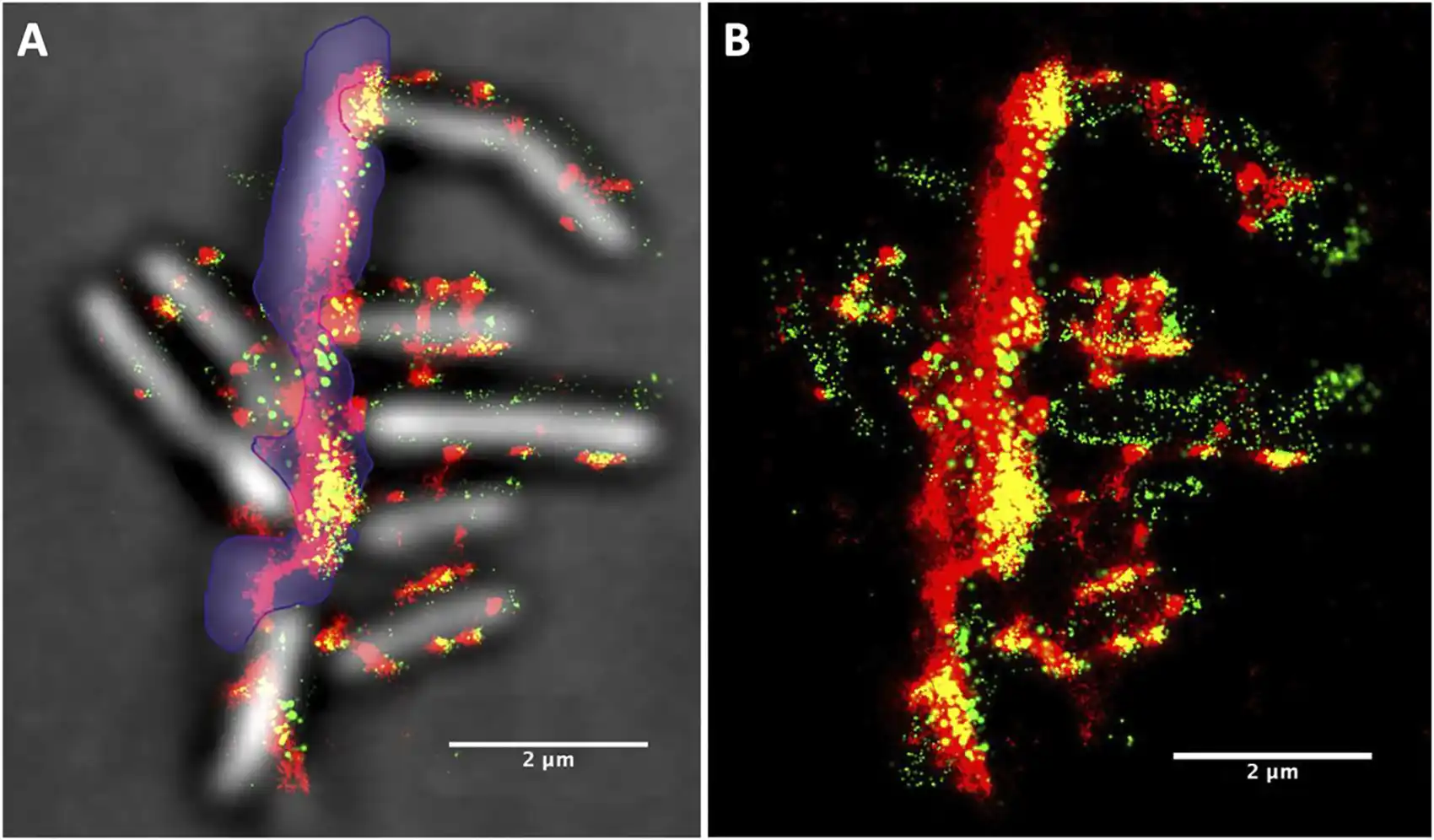
Using a clustering algorithm and machine learning, a team of researchers analyzed 15,000 images of nearly 125 Clostridium thermocellum bacteria. The result is data-rich pictures showing the location of cellulosomes. Here, areas in yellow, green, and red show where cellulosomes are clustered on plant biomass particles (shaded in purple). The white rod-like shapes in the left photo are the bacteria. Figure by John Yarbrough, National Laboratory of the Rockies
<関連情報>
- https://www.nlr.gov/news/detail/program/2026/super-resolution-microscopy-provides-real-time-picture-of-bacteria-degrading-biomass-with-enzyme-complexes
- https://www.life-science-alliance.org/content/9/3/e202503239
C. thermocellumによる分解―微生物を介したセルロソームの動的な再分配まで― Deconstruction by C. thermocellum—from microbe mediated to dynamic redistribution of cellulosomes
John M Yarbrough, N Hengge, Qi Xu, Samantha J Ziegler, Daehwan Chung, Shu Huang, Sarah Moraïs, Itzhak Mizrahi, View Edward A Bayer, Yannick J Bomble
Life Science Alliance Published: 16 January 2026
DOI:10.26508/lsa.202503239
Abstract
Clostridium thermocellum is one of the most efficient microorganisms for the deconstruction of cellulosic biomass. To achieve this high level of cellulolytic activity, C. thermocellum uses large multienzyme complexes known as cellulosomes to break down complex polysaccharides, notably cellulose, found in plant cell walls. The attachment of bacterial cells to the nearby substrate via the cellulosome has been hypothesized to be the reason for this high efficiency. The region lying between the cell and the substrate has shown great variation and dynamics that are affected by the growth stage of cells and the substrate used for growth. Here, we used both super-resolution imaging and machine-learning approaches to study the distribution of C. thermocellum cellulosomes at different stages of growth. We show that C. thermocellum initially retains its cellulosomes primarily on the cell surface but then relocates large cellulosome clusters to the interface with biomass, therefore depleting its cell surface of cellulosomes. These results indicate dynamic redistribution of cellulosomes during growth, with a functional shift toward substrate-associated degradation later during growth on biomass.
