2026-03-17 国立長寿医療研究センター
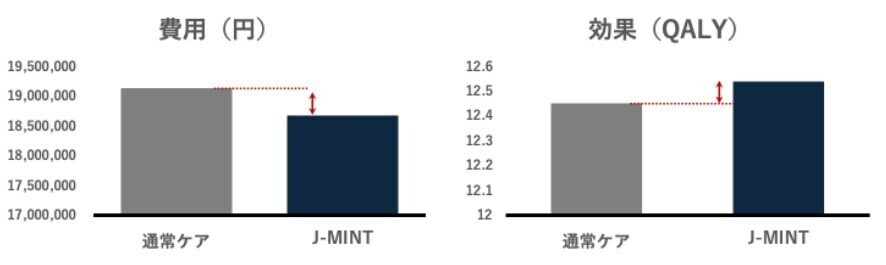
(左図)J-MINTプログラムと通常ケアの長期的な総費用の比較(右図)J-MINTプログラムと通常ケアのQALY(生活の質を考慮した生存年)の比較
<関連情報>
- https://www.ncgg.go.jp/ri/report/20260317.html
- https://www.sciencedirect.com/science/article/pii/S2274580725004017
日本における認知症予防のための多角的介入の費用対効果 Cost-effectiveness of multimodal intervention for the prevention of dementia in Japan
Naoki Takashi, Shosuke Ohtera, Yujiro Kuroda, Hidenori Arai, Takashi Sakurai , J-MINT investigators
The Journal of Prevention of Alzheimer’s Disease Available online: 1 January 2026
DOI:https://doi.org/10.1016/j.tjpad.2025.100460
Abstract
Background
This analysis evaluated the potential cost-effectiveness of the Japan-Multimodal Intervention Trial for the prevention of dementia (J-MINT), targeting older adults with mild cognitive impairment (MCI) from a societal perspective.
Methods
Using a time-dependent cohort state-transition model, we estimated the long-term economic impact of J-MINT. Costs included medical, long-term, and informal care. Incremental cost-effectiveness ratios (ICERs) were calculated based on simulated costs and quality-adjusted life years (QALYs).
Results
The base-case analysis indicated that the J-MINT was dominant, demonstrating cost saving and more effective compared to usual care. Over 35 years, J-MINT was projected to achieve cost savings of JPY 452,826 per person and a gain of 0.08 QALYs. Deterministic and probabilistic sensitivity analyses confirmed the robustness of these findings. Scenario analysis suggested that targeting APOE ε4 carriers or individuals with high adherence to exercise yielded even greater benefits.
Conclusion
J-MINT demonstrates cost-effectiveness by reducing overall care costs while improving QALYs in individuals with MCI.