2026-08-13 中国科学院(CAS)
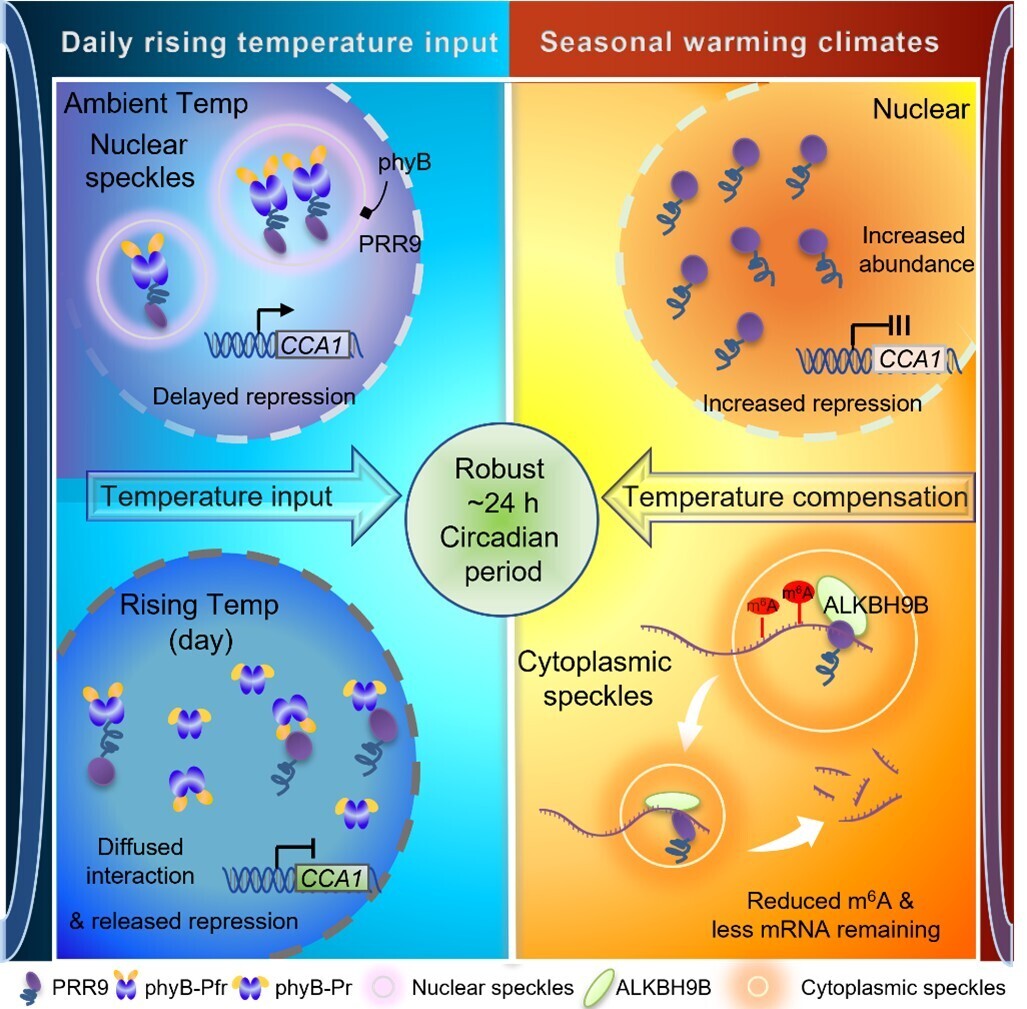
Graphical representation of the thermoregulatory module for timekeeping. (Image by HE Yuqing and WANG Xiling)
<関連情報>
- https://english.cas.cn/newsroom/research-news/202608/t20260813_1187887.shtml
- https://www.sciencedirect.com/science/article/abs/pii/S1534580726002807
シロイヌナズナにおける時間計測のための体温調節モジュール A thermoregulatory module for timekeeping in Arabidopsis
Yuqing He, Xiling Wang, Chen Su, Yufan Niu, Yumei Qin, Jiashuo Zhang, Lei Wang
Developmental Cell Available online: 7 August 2026
DOI:https://doi.org/10.1016/j.devcel.2026.07.011
Highlights
- PRR9 transmits temperature input and modulates temperature compensation
- High temperature promotes PRR9 protein accumulation and phase separation
- Temperature regulates the interactions between phyB and PRR9
- PRR9 recruits m6A eraser ALKBH9B at high temperatures to maintain circadian speed
Summary
Circadian clocks enable plants to predict temperature changes and adapt to the living climate, known as temperature entrainment and temperature compensation (TC), with largely unrevealed mechanisms. Here, we proposed that the circadian component PRR9 (PSEUDO-RESPONSE REGULATOR 9) has evolved for thermal adaptation by acting as a hub factor in transmitting temperature input and maintaining TC. High temperature promotes PRR9 protein accumulation and triggers liquid-liquid phase separation, which not only directly inhibits the transcription level of CCA1 but also facilitates the recruitment of ALKBH9B to remove m6A installation and accelerates CCA1 mRNA degradation. Moreover, we proposed a phyB-PRR9 thermoregulatory module to transmit progressively rising temperature via temperature-dependent interacting compartment alteration that regulates the repressive phase and activity of PRR9. Our findings unmasked plants that possess intricate high-temperature sensing mechanisms for adaptation to warming climates, laying a foundation for engineering thermo-resilient crops.