20206-08-19 名古屋大学
<関連情報>
- https://www.nagoya-u.ac.jp/researchinfo/result/2026/08/post-1052.html
- https://academic.oup.com/nar/article/54/15/gkag797/8760021
RPL41は哺乳類においてリボソームの動態を安定化させ、長鎖タンパク質の恒常性を維持する RPL41 stabilizes ribosome dynamics and supports long-protein homeostasis in mammals
Mina Hirata,Maho Fujino,Kazuya Ichihara,Ronghao Tang,Momoko Narita,Wakana Iwasaki,Chisa Shiraishi,Taichi Shiraishi,Atsushi Hatano,Toru Suzuki,…
Nucleic Acids Research Published:19 August 2026
DOI:https://doi.org/10.1093/nar/gkag797
Abstract
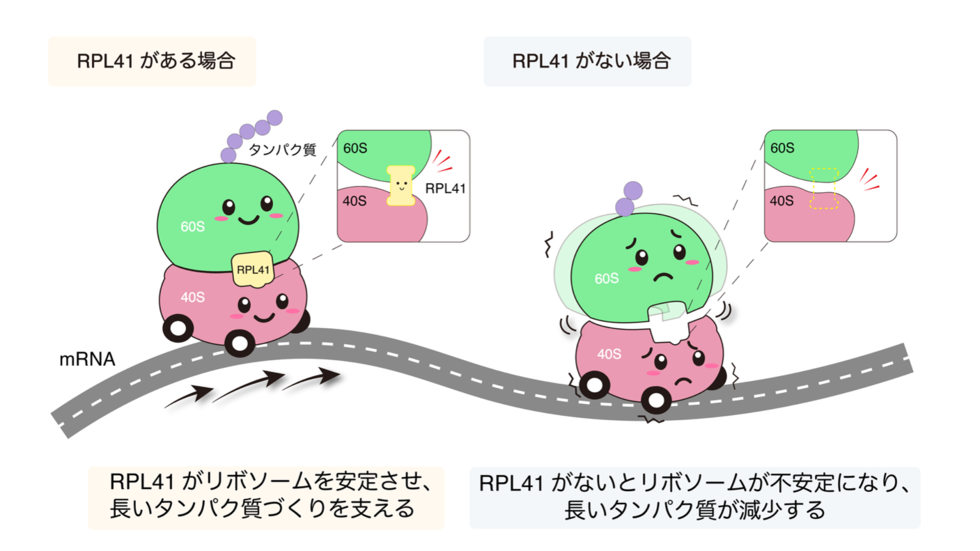
Ribosomal protein L41 (RPL41 or eL41) is the smallest ribosomal protein and forms the eukaryote-specific bridge, eB14, near the decoding center; however, its role in mammalian translation remains unclear. In this study, we established RPL41-deficient models of human HEK293T cells and mice to define its function. Cryo-electron microscopy revealed that RPL41 constrains intersubunit conformational dynamics without inducing major local static rearrangements. Loss of RPL41 altered A-site dynamics, slowed elongation, modestly increased amino acid misincorporation, and modestly enhanced readthrough of collision-inducing reporter sequences. Quantitative proteomic analysis suggested that these translational defects compromise long-protein homeostasis, as evidenced by increased insolubility and reduced abundance of long proteins. In vivo, Rpl41−/− mice were viable but exhibited growth retardation and decreased abundance of long proteins in tissues. Our findings reveal a conserved role for RPL41 in maintaining ribosome dynamics and translational fidelity, indicating that RPL41 supports ribosome function and long-protein homeostasis in mammals.