
2026-08-21 京都大学
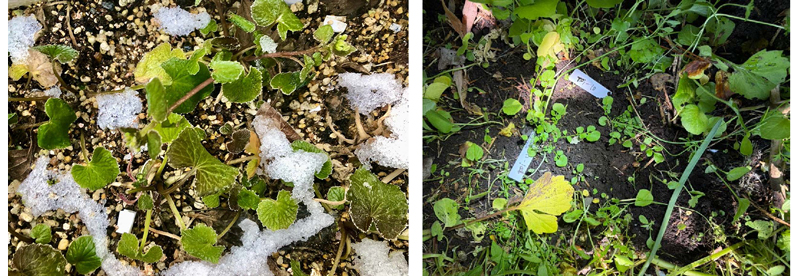
本研究で対象としたワサビ(Eutrema japonicum、左)とハクサンハタザオ(Arabidopsis halleri、右)
<関連情報>
- https://www.kyoto-u.ac.jp/ja/research-news/2026-08-21
- https://journals.plos.org/plosone/article?id=10.1371/journal.pone.0336733
⾃然環境における、系統的に⼤きく異なる2種の多年⽣アブラナ科植物に保存された、遺伝⼦およびネットワークレベルの気温記憶期間 Conserved gene- and network-level thermal memory intervals in two divergent perennial crucifers in nature
Yoshikazu Endo,Haruki Nishio,Oguchi Taichi,Kyoko Yamane,Victoria Faith Eseese,Clarissa Frances Frederica,Hiroshi Kudoh,Diana Mihaela Buzas
PLOS One Published: August 19, 2026
DOI:https://doi.org/10.1371/journal.pone.0336733
Abstract
Some biological responses persist long after the initial stimulus has disappeared—a phenomenon termed cellular memory. In its long-term form, cellular memory often reflects interactions between cis-acting chromatin states and diffusible trans-acting regulators, experimentally difficult to separate in vivo. A key challenge is to develop a quantitative and reliable framework that captures the duration of cellular memory without prior mechanistic knowledge. The FLOWERING LOCUS C (FLC) gene illustrates this problem and opportunity: a Polycomb/Trithorax cis-acting chromatin switch at FLC produces bistable ON/OFF transcriptional states, while trans-acting factors such as VERNALIZATION INSENSITIVE 3 (VIN3) and FLOWERING LOCUS T (FT) modulate transitions between those states. While laboratory studies typically view memory as the persistence of a state after a signal disappears, annual field censuses reveal a time-integrative mode of memory where FLC integrates fluctuating environmental signals over past intervals. To quantify such long-term effects systematically, we formalized the thermal memory interval (TMI), the time window of past environmental cues that best predicts current gene expression—as a consistent metric. We applied TMI to the VIN3–FLC–FT module in perennial Brassicaceae with divergent life histories: Arabidopsis halleri subsp. gemmifera and Eutrema japonicum, introduced here to test generality across species. TMIs distinguished spring versus autumn FLC states and revealed distributed memory across the VIN3-FLC-FT network, with intervals from 1–150 days, extending previously reported timescales. Crucially, a regression model forecasted dynamics in an independent year, showing that integrated thermal history explains the timing of seasonal phase switching across the VIN3–FLC–FT network. While TMIs require dense time-series data and do not by themselves reveal molecular mechanism, they offer a robust, quantitative, and generalizable framework: TMIs can be extended to other genes and to alternative environmental or physiological variables, enabling direct, comparative quantification of cellular memory across genes, species, and contexts.

