2026-09-10 中国科学院(CAS)
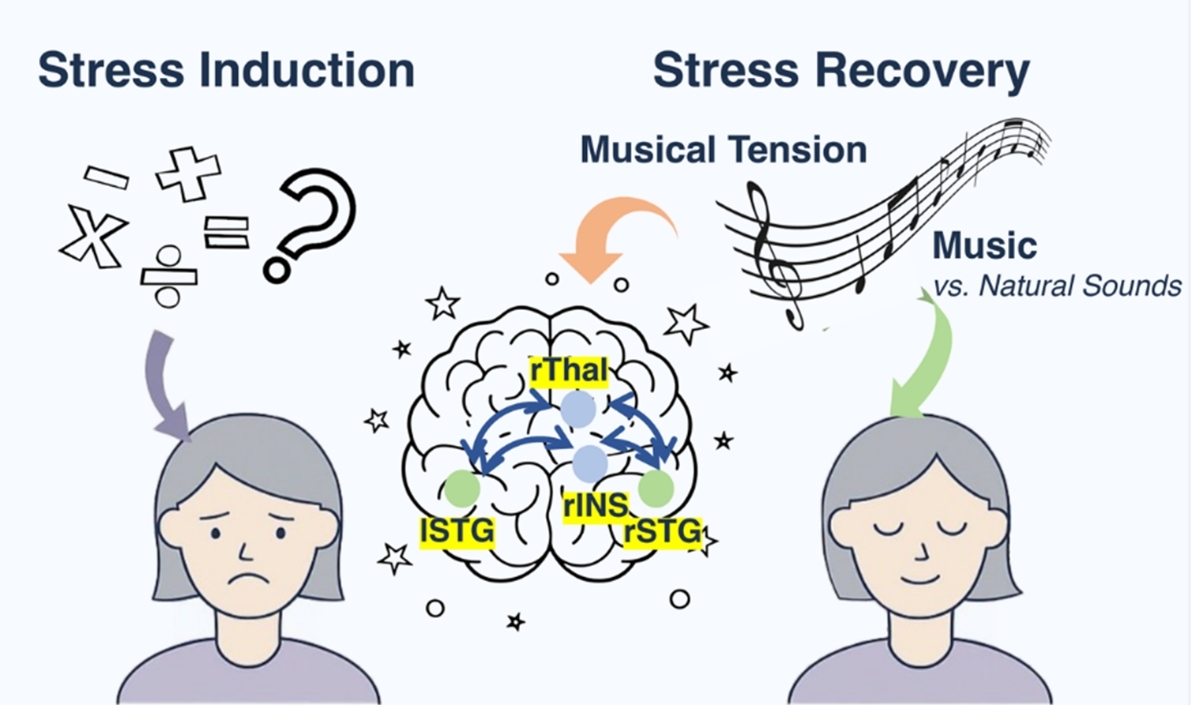
How music reorganizes the brain to bounce back from stress. (Image by YOU Siqi)
<関連情報>
- https://english.cas.cn/newsroom/research-news/202609/t20260907_1192713.shtml
- https://www.pnas.org/doi/10.1073/pnas.2611584123
音楽の構造的ダイナミクスは、ストレス調節ネットワークの機能的再編成を通じて、急性ストレスからの回復を促進する The structural dynamics of music drive acute stress recovery through functional reorganization of stress-regulation networks
Siqi You, Lei Zhang, Guowei Wu, and Yi Du
Proceedings of the National Academy of Sciences Published:September 8, 2026
DOI:https://doi.org/10.1073/pnas.2611584123
Abstract
Music is widely utilized to support recovery from stress, yet the precise neural mechanisms driving this therapeutic effect remain poorly understood. Crucially, it has been unclear whether music provides unique neurobiological benefits or simply acts as a general, relaxing auditory stimulus. Here, we demonstrate that music selectively facilitates multisystem recovery from acute stress—enhancing positive mood (PM) and accelerating autonomic stabilization (electrodermal activity and heart rate)—significantly outperforming an active natural sound control. Using functional MRI and dynamic causal modeling, we revealed the network architecture underlying this advantage. Compared to natural sounds, music drives a distinct reorganization of stress-regulation networks, establishing a directional, causal pathway from the auditory cortex to the insula and thalamus. On a faster timescale, dynamic functional connectivity reveals that this network reconfiguration is actively governed by musical structure: moment-to-moment fluctuations in perceived musical tension track transient shifts from stress-network engagement to neural downregulation. Furthermore, these music-specific connectivity changes are directly associated with improvements in PM. Together, these findings identify a temporally evolving mechanism by which the brain’s processing of structured musical sequences acts as a dynamic regulatory driver, reconfiguring neural architectures to restore psychological and physiological homeostasis.