2026-10-29 ロックフェラー大学
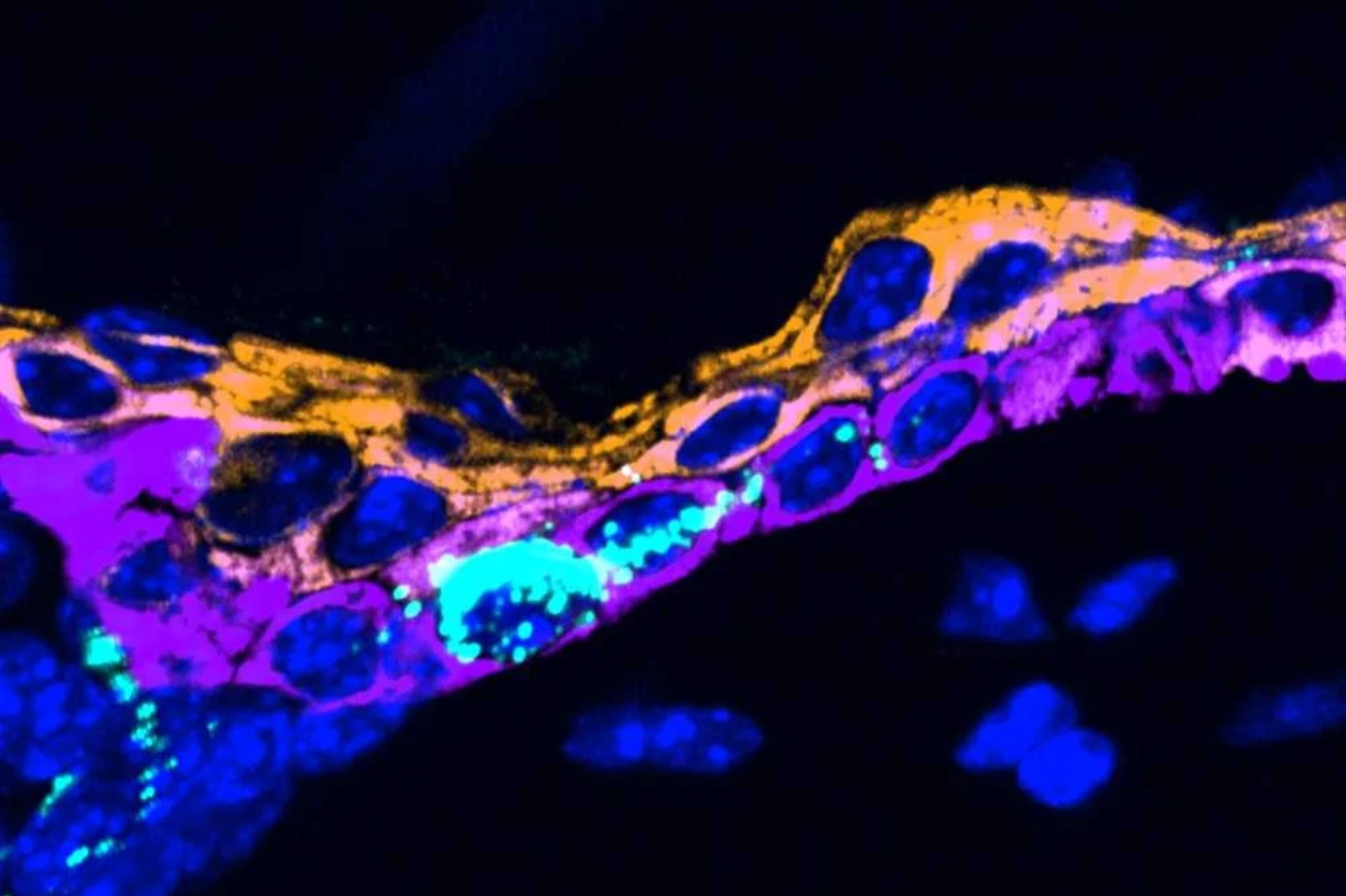
Immune cells, pictured here in bright teal, occupy the epithelial layers between the skin surface and its stem cells and act as a system regulator. (Credit: Fuchs lab)
<関連情報>
- https://www.rockefeller.edu/news/40832-skin-epidermal-stem-cells-immune-system-langerhans/
- https://www.science.org/doi/10.1126/science.aee5920
共生生物によって調節される免疫調節器が皮膚バリア機能の微調整を行う A commensally regulated immune rheostat fine-tunes skin barrier fitness
Anita Gola, Rohith Srinivas, Elias G. Rodig, Marina Schernthanner, Merve Deniz Abdusselamoglu, Matthew T. Tierney, Natalie J. Alexander, Kevin A. U. Gonzales, Sairaj M. Sajjath, […] , and Elaine Fuchs
Science Published:29 Oct 2026
DOI:https://doi.org/10.1126/science.aee5920
Abstract
At the skin’s surface, the epidermis must balance stem cell renewal with barrier maintenance to withstand environmental stress and shield against pathogens. In this study, we identify a microbial-immune-epithelial feedback mechanism that integrates environmental information into stem cell regulation in mice. Specifically, we show that Langerhans cells (LCs), an intraepithelial macrophage population, orchestrate this circuit by producing prostaglandin E2, which restrains stem cell proliferation, promotes epidermal differentiation, and maintains barrier integrity during homeostasis. Upon pathway disruption, stem cells become overactivated, hindering terminal differentiation and weakening barrier function. Upstream, LC activity is tuned by the local microbial environment in a rheostat-like fashion, coupling commensal sensing to stem cell dynamics. Our findings provide a general framework for how barrier tissues achieve adaptive homeostasis amid continual external fluctuations.